有序集合要支持查找、插入、删除、按名次取元素,红黑树和 AVL 用确定性的平衡不变量保证 \(O(\log n)\) 最坏界,代价是插删时分情况修复。Treap 和跳表换了一条路:不维护不变量,而是让结构的形状由随机数决定,于是对任意输入序列,期望代价都是 \(O(\log n)\)。这两种结构的介绍很多,常见的说法里有几处经不起核对:把 Treap 的”期望高度”写成 \(2\ln n\)(\(2\ln n\) 是平均深度的主项,高度约为 \(4.311\ln n\));说”跳表比平衡树快”(Pugh 自己的实验里 AVL 树查找更快,他的摘要只说插入和删除快);说 Redis 选跳表是因为并发友好(antirez 给出的三条理由里没有并发);说跳表第 2 层有 \(1/p\) 比例的节点(应为 \(p\))。
本文先把对手模型说清楚,再按原始论文推导 Treap
的深度、旋转次数和 split/merge,跳表的查找路径长度和 \(p\) 的取舍,每个公式都用
reproduce/ 里的程序计数核对;然后逐一对照 Redis
7.2.5、LevelDB 1.23、RocksDB 9.7.4、JDK 21
的源码,看生产实现取了什么参数、为什么;最后讨论”跳表是否更快”和”对手看得见随机数”这两个至今仍有新论文的问题。并发跳表的无锁算法由并发跳表一文展开,这里只列各实现的并发约定。
一、问题与对手模型
期望是对谁取的
两种结构的随机性都来自算法内部:Treap 给每个节点一个随机优先级,跳表给每个节点一个随机高度。输入的键序列可以是任意的,包括升序、降序或专门构造的序列。“期望 \(O(\log n)\)”的意思是:对每一个固定的操作序列,在算法自己的随机数上取期望。
这个保证成立有一个前提:操作序列不能依赖算法抽到的随机数。Pugh 在 CACM 论文里把它写成了明确的假设:
We assume an adversarial user does not have access to the levels of nodes; otherwise, he could create situations with worst-case running times by deleting all nodes that were not level 1.
这类对手叫不自适应对手(oblivious adversary):它可以挑最坏的输入,但必须在看到随机数之前挑好。第十节的 E6 实验会演示违反这个假设的后果:删掉所有高于第 1 层的节点,跳表的平均查找路径从 33.9 步变成 37401 步。
与历史无关
两种结构还有一个让分析变简单的性质:当前的形状只由当前的键集合和各键抽到的随机数决定,与插入删除的先后次序无关。Treap 的这一点在第三节证明;跳表的形状显然只取决于哪些键在表里、各自高度是多少。Pugh 原文写道:“The sequence of operations that produced the current skip list does not matter.” 因此分析任何一次操作,只需要分析”\(n\) 个键、随机数独立同分布”这一种静态状态。
期望、高概率与最坏情况
期望界不说明尾部。两类结构的最坏情况都是 \(\Theta(n)\)(所有优先级恰好按键排序、所有高度都是 1),只是概率极小。Pugh 用他推导的概率上界给出过具体数字:\(p = 1/2\)、\(n = 4096\) 时,查找路径超过期望长度 3 倍的概率小于两亿分之一;摘要里另一句是,元素多于 250 个时,一次查找耗时超过期望 3 倍的概率小于百万分之一。Treap 的高度分布则由随机二叉搜索树的理论刻画(第四节)。需要确定性最坏界的场景(实时系统、内核),仍然应该用红黑树,见红黑树与 AVL。
二、谱系
flowchart LR
    V["Vuillemin 1980<br/>Cartesian tree"] --> AS["Aragon & Seidel 1989<br/>FOCS: treap"]
    M["McCreight 1985<br/>priority search tree"] -.-> AS
    AS --> SA["Seidel & Aragon 1996<br/>Algorithmica"]
    SA --> MR["Martinez & Roura 1998<br/>randomized BST"]
    SA --> BR["Blelloch & Reid-Miller 1998<br/>set operations via split/join"]
    BR --> BFS["Blelloch, Ferizovic & Sun 2016<br/>just join"]
    P0["Pugh 1989 WADS<br/>skip list"] --> P1["Pugh 1990 CACM"]
    P1 --> PC["Pugh cookbook 1990<br/>span, linear list ops"]
    P1 --> PMP["Papadakis, Munro & Poblete 1992<br/>Devroye 1992, Kirschenhofer & Prodinger 1994"]
    PC --> R["Redis zset<br/>span, rank"]
    P1 --> L["LevelDB / RocksDB memtable<br/>JDK ConcurrentSkipListMap"]
    SA --> F["Fischlin, Huppert & Markelon 2025<br/>adaptive adversary"]
    P1 --> F
Treap 一支。 Vuillemin 1980 年在 CACM 发表的 “A unifying look at data structures” 定义了 Cartesian tree:对二元组 \((x, y)\),按 \(x\) 是二叉搜索树,按 \(y\) 是堆。Aragon 和 Seidel 1989 年在 FOCS 上把 \(y\) 换成随机数,得到期望对数代价的平衡树,并起名 treap(tree + heap);期刊版 1996 年发表于 Algorithmica,给出了完整的期望分析。期刊版脚注说明,“treap” 一词此前被 McCreight 用于另一种结构,McCreight 后来把那种结构改称 priority search tree(SIAM J. Comput. 1985)。Martínez 和 Roura 1998 年在 JACM 发表的随机二叉搜索树不存优先级,而是用子树大小决定新节点以多大概率插到根,得到同样的形状分布。Blelloch 和 Reid-Miller 1998 年用 treap 的 split/join 实现集合的并、交、差并做了并行分析;Blelloch、Ferizovic 和 Sun 2016 年进一步说明,AVL、红黑树、加权平衡树和 treap 只要各自实现一个 join,其余集合操作都可以用同一套算法写出。
跳表一支。 Pugh 1989 年在 WADS
上首次发表跳表,1990 年的 CACM
版本给出了本文第七节的逆向分析和 \(p\)
的推荐值。同年修订的技术报告 A Skip List Cookbook
给每个指针附加”跨过了多少个元素”,从而支持按位置访问,Redis
有序集合的 span 字段就是这个技术。之后
Papadakis、Munro 和 Poblete(BIT
1992)给出查找代价的精确均值,Devroye(Annals of Applied
Probability 1992)给出查找代价的极限分布,Kirschenhofer 和
Prodinger(Acta Informatica 1994)分析了路径长度。
对手模型一支。 两条线在 2025 年交汇:Fischlin、Huppert 和 Markelon 在 ACM CCS 2025 上研究能观察结构的自适应对手,发现只用插入就能让跳表退化成线性,而 treap 对同一类对手天然稳健(第十二节)。
三、Treap:定义、唯一性与旋转
定义
每个节点有键 \(k\) 和优先级 \(\pi\)。Treap 同时满足:
- 按键是二叉搜索树:左子树的键都小于节点的键,右子树的键都大于节点的键;
- 按优先级是大根堆:父节点的优先级大于子节点。
本文沿用 Seidel–Aragon 的大根堆约定。也有实现用小根堆,两者把优先级取负即可互换,但同一份代码里必须统一。
唯一性:形状等于”按优先级降序插入”的 BST
命题:若键两两不同、优先级两两不同,则满足上述两条的树唯一,且等于把各键按优先级从大到小依次插入普通 BST 得到的树。
证明只需归纳:堆序要求根是优先级最大的节点;BST 序要求比根小的键全在左子树、比根大的全在右子树;两棵子树各自又是 treap,由归纳假设唯一。按优先级降序插入 BST 时,第一个插入的就是优先级最大的键,它成为根,其余键按大小分到两侧,递归结构相同。
这个命题不需要任何随机性。随机性的作用在下一步:优先级独立同分布时,“按优先级降序”是 \(n\) 个键的一个均匀随机排列,所以 treap 的形状分布与”按均匀随机顺序插入 BST”完全相同,而与实际的插入顺序无关。普通 BST 最怕的升序插入,对 treap 没有影响。
实验 E0 检验这一点:\(n = 2000\),同一组(键, 优先级)分别用”升序 + 旋转插入”和”乱序 + split/merge 插入,并夹杂额外的插入删除”两种方式建树,200 次试验中 200 次得到逐节点相同的树。
旋转
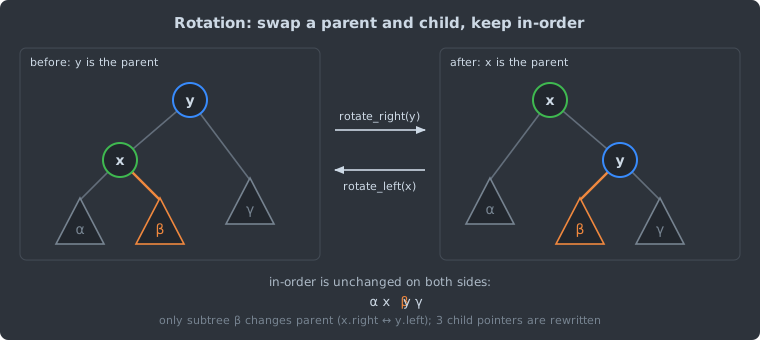
旋转是 treap 修复堆序的唯一手段。它保持中序序列不变,只改变两个节点的父子关系,需要更新子树大小的也只有这两个节点。
插入:先按 BST 挂到叶子,再往上转
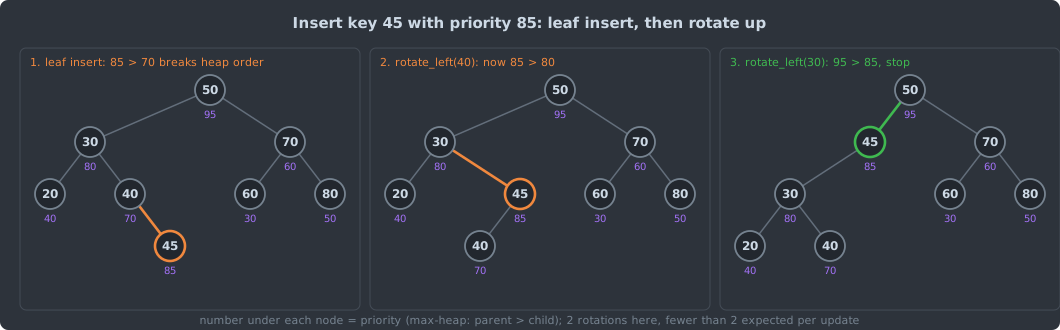
新节点先按 BST
规则挂成叶子;只要它的优先级比父节点大,就把它往上旋转一次。reproduce/treap.h
中的实现(顺带计数旋转次数):
static inline tnode *treap_insert_rot(tnode *t, tnode *x, long *rotations, int *inserted)
{
    if (!t) { *inserted = 1; return x; }
    if (x->key == t->key) { *inserted = 0; return t; }
    if (x->key < t->key) {
        t->l = treap_insert_rot(t->l, x, rotations, inserted);
        if (t->l->prio > t->prio) { t = rotate_right(t); ++*rotations; return t; }
    } else {
        t->r = treap_insert_rot(t->r, x, rotations, inserted);
        if (t->r->prio > t->prio) { t = rotate_left(t); ++*rotations; return t; }
    }
    pull(t);
    return t;
}
删除反过来:把目标节点往优先级较大的那个孩子方向旋转下去,直到它成为叶子,再摘掉。
四、Treap 的期望代价
以下设键的名次为 \(1, \ldots, n\),记名次为 \(\ell\) 的键为 \(x_\ell\),调和数 \(H_m = \sum_{i=1}^{m} 1/i\)。
祖先引理
引理(Seidel–Aragon 推论 4.5):\(x_i\) 是 \(x_j\) 的祖先(含 \(i = j\))的概率为
\[ \Pr[x_i \text{ 是 } x_j \text{ 的祖先}] = \frac{1}{|i - j| + 1}. \]
证明:考虑名次落在 \(i\) 与 \(j\) 之间(含两端)的 \(|i-j|+1\) 个键,看其中优先级最大的那个 \(y\)。按”降序插入”的视角,\(y\) 是这段键里第一个被插入的;在它之前插入的键都在这段之外,不会把这段键分开,所以这段键在 \(y\) 之前都走同一条路径,\(y\) 是它们的公共祖先。若 \(y = x_i\),则 \(x_i\) 是 \(x_j\) 的祖先;若 \(y\) 在两者之间,\(x_i\) 和 \(x_j\) 分别落在 \(y\) 的两侧子树,互不为祖先;若 \(y = x_j\),则反过来。优先级独立同分布,这段键中每个都以同样概率 \(1/(|i-j|+1)\) 是最大者。
期望深度
记 \(D(x_\ell)\) 为根到 \(x_\ell\) 路径上的节点数(含自身),它等于 \(x_\ell\) 的祖先个数。对 \(i\) 求和:
\[ \mathbb{E}[D(x_\ell)] = \sum_{i=1}^{n} \frac{1}{|i-\ell|+1} = H_\ell + H_{n+1-\ell} - 1 < 1 + 2\ln n. \]
这是 Seidel–Aragon 定理 4.7(i)。再对 \(\ell\) 取平均,利用 \(\sum_{\ell=1}^{n} H_\ell = (n+1)H_n - n\):
\[ \frac{1}{n}\sum_{\ell=1}^{n} \mathbb{E}[D(x_\ell)] = 2\left(1 + \frac{1}{n}\right)H_n - 3 \approx 2\ln n. \]
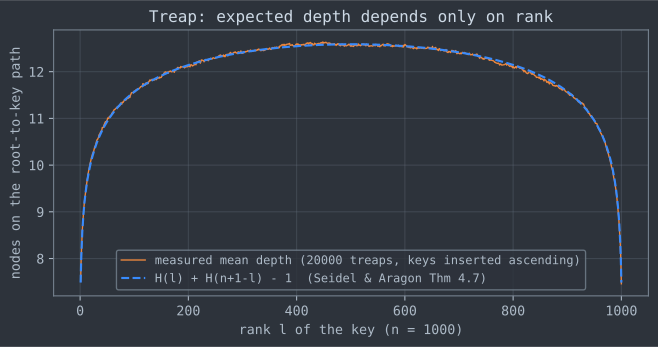
实验 E1:\(n = 1000\),键按升序插入,20000 次试验。每个名次的实测平均深度与公式的最大偏差为 0.0874;全体节点的平均深度为 11.9805,公式为 11.9859;名次 1 为 7.5132(公式 7.4855),名次 500 为 12.5453(公式 12.5876)。深度只依赖名次、中间深两端浅,这个形状在升序插入下依然成立。
高度不是 \(2\ln n\)
\(2\ln n\) 是平均深度的主项。树的高度是最深那个节点的深度,比平均值大得多。Treap 的形状与随机 BST 同分布,所以直接适用随机 BST 的结果:Devroye(JACM 1986)证明高度 \(h_n\) 满足 \(h_n / \ln n \to \alpha\)(依概率),其中 \(\alpha \approx 4.311\) 是方程 \(\alpha\ln(2e/\alpha) = 1\) 大于 2 的根;Reed(JACM 2003)进一步得到
\[ \mathbb{E}[h_n] = \alpha\ln n - \beta\ln\ln n + O(1), \qquad \beta = \frac{3}{2\ln(\alpha/2)} \approx 1.953, \]
并证明方差有界;Drmota(JACM 2003)用解析方法独立得到方差有界的结论。
实验 E3 统计高度(以节点数计)与平均深度,高度取各次试验的中位数:
| \(n\) | 试验次数 | 插入顺序 | 平均深度 | 公式 \(2(1+1/n)H_n - 3\) | 高度 最小/中位/最大 | 中位高度 / \(\log_2 n\) | \(\alpha\ln n - \beta\ln\ln n\) |
|---|---|---|---|---|---|---|---|
| \(10^3\) | 1000 | 升序 | 11.892 | 11.986 | 18 / 22 / 30 | 2.208 | 26.01 |
| \(10^3\) | 1000 | 乱序 | 11.930 | 11.986 | 17 / 22 / 30 | 2.208 | 26.01 |
| \(10^4\) | 300 | 升序 | 16.467 | 16.577 | 26 / 31 / 43 | 2.333 | 35.37 |
| \(10^4\) | 300 | 乱序 | 16.504 | 16.577 | 27 / 31 / 38 | 2.333 | 35.37 |
| \(10^5\) | 50 | 升序 | 21.122 | 21.181 | 38 / 40.5 / 48 | 2.438 | 44.86 |
| \(10^5\) | 50 | 乱序 | 21.050 | 21.181 | 37 / 40.5 / 49 | 2.438 | 44.86 |
| \(10^6\) | 11 | 升序 | 25.840 | 25.785 | 48 / 51 / 57 | 2.559 | 54.43 |
| \(10^6\) | 11 | 乱序 | 25.188 | 25.785 | 47 / 50 / 53 | 2.509 | 54.43 |
三点:平均深度与公式吻合,升序和乱序没有系统差别;中位高度约为平均深度的 2 倍,比值 \(h/\log_2 n\) 从 2.2 缓慢增大,极限是 \(\alpha\ln 2 \approx 2.99\);渐近式在这些规模下比实测中位数高 3.4 到 4.4,这就是 \(O(1)\) 项的量级。作为对比,红黑树的最坏高度是 \(2\log_2(n+1)\),在 \(n = 10^6\) 时约为 40;treap 的典型高度(51)已经超过红黑树的最坏高度,但决定查找代价的是平均深度(约 26),而不是高度。
旋转次数期望小于 2
插入时新节点每上旋一次,它左子树的右脊或右子树的左脊就长一节;新节点作为叶子时两条脊长度都是 0。所以一次插入的旋转次数等于新节点最终位置上”左子树右脊长 \(SL\) + 右子树左脊长 \(SR\)“;删除是插入的逆过程,旋转次数相同。Seidel–Aragon 定理 4.7(iv) 给出
\[ \mathbb{E}[SL(x_\ell)] = 1 - \frac{1}{\ell}, \qquad \mathbb{E}[SR(x_\ell)] = 1 - \frac{1}{n+1-\ell}, \]
因此每次更新的期望旋转次数小于 2;若更新的名次均匀随机,平均为 \(2 - 2H_n/n\)。
实验 E2:先建 \(n\) 个键的 treap,再做 \(n\) 对”删除一个随机键、插入一个新随机键”,统计每次操作的平均旋转次数:
| \(n\) | 插入 | 删除 | \(2 - 2H_n/n\) |
|---|---|---|---|
| 1000 | 2.0340 | 2.0020 | 1.9850 |
| 10000 | 2.0181 | 1.9871 | 1.9980 |
| 100000 | 1.9905 | 1.9991 | 1.9998 |
| 1000000 | 2.0043 | 1.9997 | 2.0000 |
\(n = 1000\) 时只有 1000 次更新,0.05 的偏差在抽样误差量级;规模增大后实测收敛到公式。与红黑树相比:红黑树插入最多 2 次旋转、删除最多 3 次,是最坏界;treap 的 2 是期望,单次可以更多,但不需要颜色修复。
优先级要多”随机”
上面的分析假设优先级完全独立。Seidel–Aragon 定理 3.3 放宽了这一要求:优先级只需 8 维独立(8-wise independent),各期望界就在常数因子内保持;5 维独立即可保证查找和更新的期望对数时间。第 7 节还讨论了不存储优先级的做法:用键的哈希值当优先级(文中记为 Sleator 的建议)、用节点地址,或像 Martínez–Roura 那样改用子树大小。哈希优先级省空间,还让结构成为键集合的确定函数,但也意味着知道哈希函数的人可以构造出退化的键集合,这回到了第一节的对手模型。
五、Split 与 Merge
两个原语
- \(\mathrm{split}(T, k)\):把 \(T\) 拆成 \(L\)(键 \(< k\))和 \(R\)(键 \(\ge k\));
- \(\mathrm{merge}(L, R)\):前提是 \(L\) 的键全小于 \(R\) 的键,合成一棵 treap。
/* *l gets keys < key, *r gets keys >= key. */
static inline void treap_split(tnode *t, int64_t key, tnode **l, tnode **r)
{
    if (!t) { *l = *r = NULL; return; }
    if (t->key < key) {
        treap_split(t->r, key, &t->r, r);
        *l = t;
    } else {
        treap_split(t->l, key, l, &t->l);
        *r = t;
    }
    pull(t);
}

/* Precondition: every key in l is smaller than every key in r. */
static inline tnode *treap_merge(tnode *l, tnode *r)
{
    if (!l) return r;
    if (!r) return l;
    if (l->prio > r->prio) {
        l->r = treap_merge(l->r, r);
        pull(l);
        return l;
    }
    r->l = treap_merge(l, r->l);
    pull(r);
    return r;
}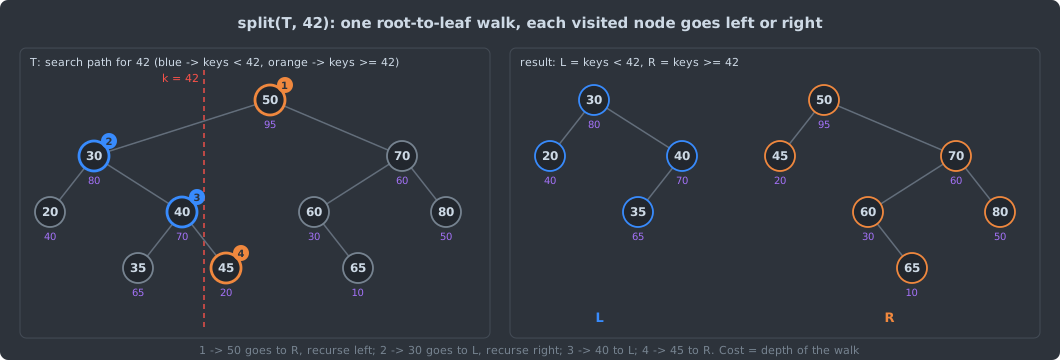
split 沿查找 \(k\) 的路径走一遍,路径上每个节点根据键与 \(k\) 的大小归入左边或右边,并把它另一侧的子树整棵带走。代价等于这条路径的长度,期望 \(O(\log n)\)。堆序不会被破坏:每个节点的新孩子都来自它原来的子树。
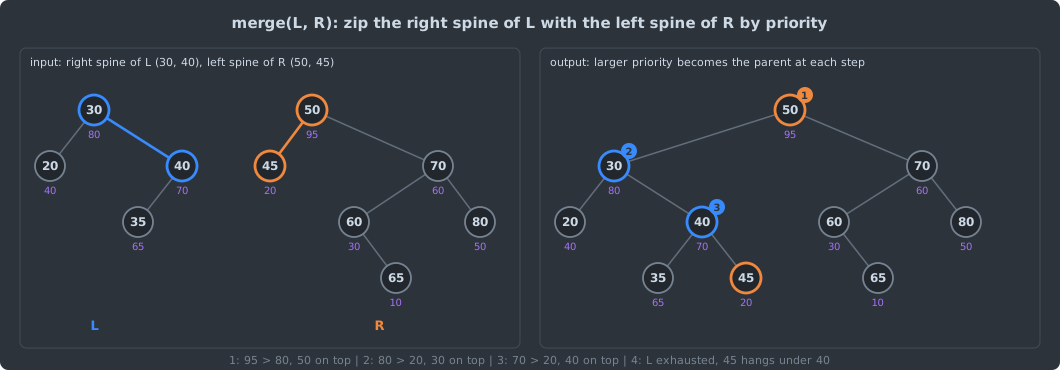
merge 每步比较两个根的优先级,大的做根,然后把另一棵与它的内侧子树递归合并。走过的是 \(L\) 的右脊和 \(R\) 的左脊,期望长度也是 \(O(\log n)\)。
用 split/merge 做插入和删除
Seidel–Aragon 期刊版把 split 描述为”插入一个键为 \(k\)、优先级为 \(+\infty\) 的节点再摘掉根”,把
join 描述为”加一个哑根再删除它”;脚注 2 又说明,实践中 split
和 join
最好写成自顶向下的迭代过程,而插入删除可以实现为”一次访问加一次
split 或 join”。本文 treap.h 的 split/merge
风格插入删除正是这样:
- 插入:沿路径下降,直到遇到优先级比新节点小的节点 \(t\),把 \(t\) 这棵子树按新键 split,两半挂到新节点下面;
- 删除:找到目标节点,用其左右子树的 merge 替换它。
中文竞赛资料常把这种写法叫”无旋 Treap”或”FHQ Treap”。它和旋转版维护的是同一棵树(E0 已验证两种方式得到逐节点相同的结果),差别只在代码组织。另一个常被混在一起的概念是隐式键:不存键,而是用子树大小算出节点在中序里的位置,按位置 split,于是 treap 变成支持任意位置切分、拼接的序列结构(配合懒标记还能做区间翻转)。隐式键可以配旋转版,也可以配 split/merge 版,两件事互相独立。
名次与第 \(k\) 小
每个节点维护子树大小,treap_rank
沿路径累加左子树大小得到”比 \(k\)
小的键有几个”,treap_kth 按子树大小向下走找第
\(k\)
小,都是一条路径的代价。旋转、split、merge
只改路径上的节点,子树大小在回溯时由 pull
重算。
六、跳表:结构与查找路径
结构
第 1 层是全部元素的有序链表。每个元素插入时独立抽一个高度 \(h\):
\[ \Pr[h \ge i] = p^{\,i-1}, \qquad i = 1, 2, \ldots \]
第 \(i\) 层链表由所有 \(h \ge i\) 的元素组成,所以第 \(i\) 层期望包含 \(p^{\,i-1}\) 比例的元素:第 2 层约占 \(p\),第 3 层约占 \(p^2\)。每个元素的前向指针数就是 \(h\),期望为
\[ \mathbb{E}[h] = \sum_{i \ge 1} p^{\,i-1} = \frac{1}{1-p}. \]
\(p = 1/2\) 时平均 2 个指针,\(p = 1/4\) 时 \(4/3\) 个。E4 实测每节点指针数与此一致(下一节表格)。
查找
从头节点的最高层开始:下一个元素的键小于目标就向右走,否则向下一层。
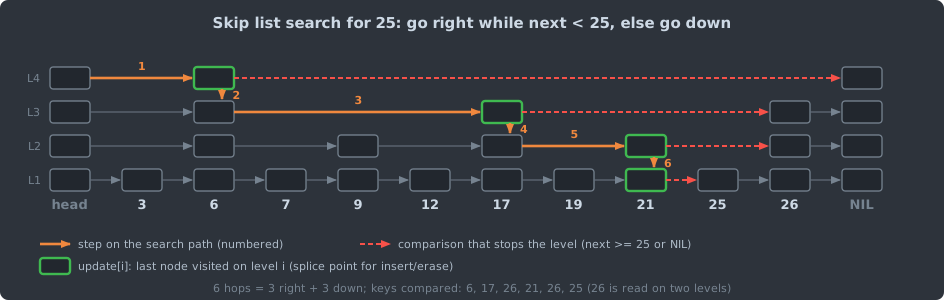
reproduce/skiplist.h 中 sl_find
去掉计数器后的形式:
static slnode *sl_search(const skiplist *sl, int64_t key)
{
    const slnode *x = sl->head;
    for (int i = sl->level - 1; i >= 0; i--)
        while (x->lv[i].next && x->lv[i].next->key < key)
            x = x->lv[i].next;
    slnode *n = x->lv[0].next;
    return n && n->key == key ? n : NULL;
}
图中值得注意的一点:26 在第 3 层和第 2 层都被比较了一次。比较次数和”读了多少个不同节点”不是一回事,后者才对应缓存未命中,第七节会看到这个区别影响 \(p\) 的选择。
插入与删除
查找过程中每层最后停留的节点记入
update[i],它们就是新节点在各层的前驱。插入时抽高度
\(h\),在第 \(1..h\) 层把新节点接在
update[i] 之后;若 \(h\)
超过当前最高层,多出的层前驱是头节点。删除时在
update[i]->next
恰为目标的各层把它摘掉,再降低空的顶层。整个过程只改 \(h\)
个前驱的指针,没有旋转,不影响其他节点;这种局部性是跳表适合做成无锁结构的原因,细节见并发跳表。
七、跳表的期望代价与 \(p\) 的选择
逆向分析
记 \(L(n) = \log_{1/p} n\),即期望恰有 \(1/p\) 个元素的那一层。Pugh 把查找路径倒过来看:从第 1 层的终点出发,往回走到头节点最高层。在路径上的某个位置、第 \(i\) 层时,若当前节点的高度大于 \(i\)(概率 \(p\)),路径是从上面下来的,倒着走就是向上;否则(概率 \(1-p\))是从左边过来的,倒着走就是向左。设在无限长的表中向上爬 \(k\) 层的期望步数为 \(C(k)\):
\[ C(0) = 0, \qquad C(k) = (1-p)\bigl(1 + C(k)\bigr) + p\bigl(1 + C(k-1)\bigr) \;\Longrightarrow\; C(k) = \frac{k}{p}. \]
爬到第 \(L(n)\) 层至多 \((L(n)-1)/p\) 步。之后的左移次数不超过高度 \(\ge L(n)\) 的元素个数,期望为 \(1/p\);从 \(L(n)\) 再往上到最高层,由 \(\Pr[\text{最高层} > k] \le n p^k\) 可得期望至多 \(1/(1-p)\) 层。合起来:
\[ \mathbb{E}[\text{查找路径长度}] \le \frac{L(n)}{p} + \frac{1}{1-p}. \]
比较次数是路径长度加 1(路径上每个位置比较一次)。主项 \(L(n)/p = \frac{1}{p\ln(1/p)}\ln n\),系数在 \(p = 1/e\) 时最小。
Pugh 的表 1 与实测
Pugh 表 1 给出以 \(p = 1/2\) 为基准的相对查找时间(按 \(L(n)/p\) 计)和每节点指针数:
| \(p\) | 相对查找时间 | 每节点指针数 \(1/(1-p)\) |
|---|---|---|
| \(1/2\) | 1 | 2 |
| \(1/e\) | 0.94 | 1.58 |
| \(1/4\) | 1 | 1.33 |
| \(1/8\) | 1.33 | 1.14 |
| \(1/16\) | 2 | 1.07 |
实验 E4:\(n = 10^6\),每个键按随机顺序成功查找一次,取 5 个独立建立的跳表的中位数。“步数”是向右加向下的移动次数,即 Pugh 的路径长度;“比较”只计与真实节点的比较,不计与表尾 NIL 的比较;“不同节点”是一次查找中读过键的不同节点个数。
| \(p\) | 步数 | Pugh 上界 | 比较 | 不同节点 | 每节点指针 | 实际最高层 | \(L(n)\) |
|---|---|---|---|---|---|---|---|
| \(1/2\) | 38.65 | 41.86 | 38.49 | 28.97 | 2.0004 | 20 | 19.93 |
| \(1/e\) | 35.47 | 39.14 | 36.42 | 31.74 | 1.5829 | 14 | 13.82 |
| \(1/4\) | 37.45 | 41.20 | 37.50 | 35.02 | 1.3334 | 10 | 9.97 |
| \(1/8\) | 48.35 | 54.29 | 48.98 | 47.50 | 1.1427 | 7 | 6.64 |
| \(1/16\) | 70.66 | 80.79 | 71.28 | 70.95 | 1.0668 | 6 | 4.98 |
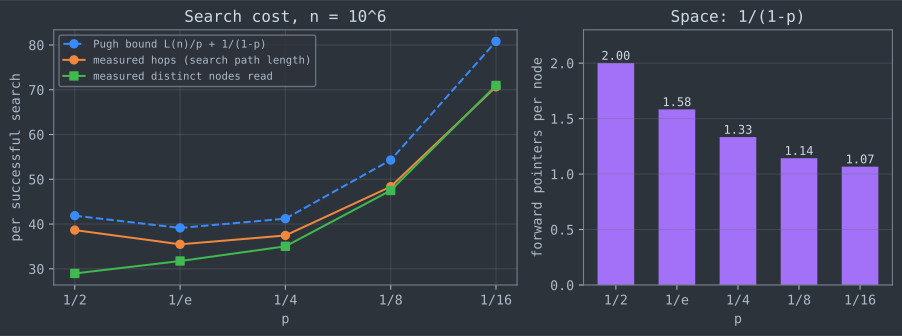
\(n = 65536\)
的同一组数据保存在
reproduce/results/exp.txt,结论相同。从表中可以读出:
- 上界在所有 \(p\) 下都成立,实测步数比上界低 8% 到 13%。以 \(p = 1/2\) 为基准,\(1/e\)、\(1/4\)、\(1/8\)、\(1/16\) 的相对步数为 0.92、0.97、1.25、1.83,与 Pugh 表 1 的 0.94、1、1.33、2 趋势一致(表 1 只计主项)。
- 不同节点数的排序与步数不同。 \(p = 1/2\) 的步数比 \(1/4\) 多,但读过的不同节点少(28.97 对 35.02):\(p\) 越大,相邻两层停在同一个节点上的概率越高,上一层已经比较过的节点在下一层再比较一次时已经在缓存里。按缓存未命中计,\(p = 1/2\) 反而更省;按比较次数计,\(1/e\) 到 \(1/4\) 最省。Pugh 的分析和表 1 只统计后者。
- 空间随 \(p\) 单调下降,每节点指针数与 \(1/(1-p)\) 的差不超过 0.002。
Pugh 的推荐与层数上限
Pugh 的建议是:除非运行时间的波动是首要关注(那时用 \(1/2\)),否则取 \(p = 1/4\);理由是减小 \(p\) 会增加波动,而部分常数开销与 \(L(n)\) 而不是 \(L(n)/p\) 成正比,取 \(1/4\) 还能略微改善常数。层数上限取 \(\mathrm{MaxLevel} = L(N)\),\(N\) 是元素个数的上界。上限低于 \(L(N)\) 不影响正确性,只是顶层链表变长:元素数超过 \((1/p)^{\mathrm{MaxLevel}}\) 之后,顶层期望有 \(n\,p^{\mathrm{MaxLevel}-1}\) 个元素,查找代价随之线性增长。第九节会用这条规则检查各实现的取值。
八、Redis 有序集合:带跨度的跳表
数据结构
Redis 7.2.5 src/server.h:
#define ZSKIPLIST_MAXLEVEL 32 /* Should be enough for 2^64 elements */
#define ZSKIPLIST_P 0.25      /* Skiplist P = 1/4 */

typedef struct zskiplistNode {
    sds ele;
    double score;
    struct zskiplistNode *backward;
    struct zskiplistLevel {
        struct zskiplistNode *forward;
        unsigned long span;
    } level[];
} zskiplistNode;

typedef struct zset {
    dict *dict;
    zskiplist *zsl;
} zset;
\(p = 1/4\) 时 \(L(N) = 32\) 对应 \(N = 4^{32} = 2^{64}\),注释与
Pugh 的规则一致。zset
同时持有字典和跳表:ZSCORE
这类按成员查分数的操作走字典,按分数范围和名次的操作走跳表。元素少时不用这套结构:redis.conf
中
zset-max-listpack-entries 128、zset-max-listpack-value 64,即元素不超过
128 个且每个成员不超过 64
字节时,整个有序集合编码为一块连续的
listpack(早期版本在同一位置用 ziplist)。
src/t_zset.c 开头的注释说,这份实现”几乎是
Pugh 算法的 C
语言翻译”,改了三处:允许重复的分数;比较时先比分数、分数相同再比成员字符串;第
1 层有后向指针,便于 ZREVRANGE
从尾到头遍历。
随机层数
int zslRandomLevel(void) {
    static const int threshold = ZSKIPLIST_P*RAND_MAX;
    int level = 1;
    while (random() < threshold)
        level += 1;
    return (level<ZSKIPLIST_MAXLEVEL) ? level : ZSKIPLIST_MAXLEVEL;
}
随机源是 libc 的 random(),每层以约 \(1/4\) 的概率继续。LevelDB
的层数才用 Park–Miller 线性同余生成器(第九节)。
span:让跳表支持按名次访问
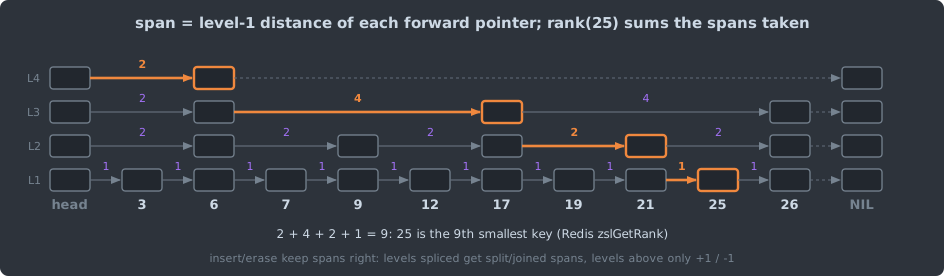
每个前向指针附带
span:从当前节点沿这个指针走到下一个节点,在第
1 层上跨过了几个元素。这是 Pugh Cookbook 第 3.4
节”线性表操作”里的
fDistance[i] = pos(forward[i]) - pos(x)。查找时沿路径累加跨过的
span,就得到目标的名次(zslGetRank,1
起算;ZRANK 返回时再减
1);反过来按名次向下走,就是
zslGetElementByRank。
插入时,查找阶段顺带记下每层前驱 update[i]
的名次 \(r_i\)(从头节点到它的第 1
层步数)。新节点的名次是 \(r_1 +
1\),在它占据的第 \(i \le
h\) 层上:
\[ \mathrm{span}(x, i) = \mathrm{span}_{\text{old}}(\mathrm{update}_i, i) - (r_1 - r_i), \qquad \mathrm{span}(\mathrm{update}_i, i) = (r_1 - r_i) + 1, \]
在更高的层 \(i > h\)
上,update[i] 的指针从新节点上方越过,跨度加
1。删除是逆过程。reproduce/skiplist.h 按
zslInsert/zslDeleteNode
的逻辑实现了这套维护,test.c
在随机插删过程中检查”span 等于两端名次之差”。
与 treap 对比:treap 用子树大小也能在 \(O(\log n)\) 内求名次,但每个节点要多存一个大小,旋转或 split 时要重算;跳表的 span 挂在指针上,只有被修改的那几层需要调整。
antirez 的三条理由
2010 年 3 月 6 日,antirez 在 Hacker News 回答”为什么有序集合用跳表而不用平衡树”(评论 1171934),原文列了三条:
- 内存占用不高,而且可调:调整节点层数的概率参数,可以比 B 树更省内存;
- 有序集合常被
ZRANGE、ZREVRANGE访问,也就是把跳表当链表遍历,这种访问的缓存局部性至少不比其他平衡树差; - 实现、调试更简单;例如他收到一个补丁,用增强的跳表实现了
\(O(\log N)\) 的
ZRANK,改动很小。
三条里没有并发。同一条评论后面谈线程时,他说的是 Redis 主要受 I/O 限制,用多核的长远方案是运行多个实例。第三条里的”增强跳表”就是上面的 span。
九、LevelDB、RocksDB 与 JDK 中的跳表
| 实现(版本) | 每层继续的概率 | 层数上限 | 随机源 | 并发约定 | 删除 |
|---|---|---|---|---|---|
Redis 7.2.5 t_zset.c |
\(1/4\) | 32 | libc random() |
结构本身不带同步 | 物理删除节点 |
LevelDB 1.23 db/skiplist.h |
\(1/4\)(rnd_.Next() % 4 == 0) |
12 | Park–Miller,seed * 16807 % (2^31-1) |
写者需外部加锁;读者无锁 | 表存活期间从不删除节点 |
RocksDB 9.7.4 InlineSkipList |
默认 \(1/4\)(branching_factor = 4) |
默认 12,硬上限 32 | 线程局部 Random |
InsertConcurrently 用 CAS |
表存活期间从不删除节点 |
JDK 21 ConcurrentSkipListMap |
首层索引 \(1/4\),之后每层 \(1/2\) | 至多 62 个索引层,每次插入最多加一层 | ThreadLocalRandom |
无锁 CAS | 标记节点后摘除 |
LevelDB。 memtable
的跳表注释写明两条约定:写操作需要外部同步,读操作不加锁;节点在跳表销毁前永不删除。后一条来自
LSM-tree
的写法:删除写的是一条墓碑记录,本身也是一次插入;memtable
写满后整体变成只读、刷盘,内存随 arena 一起释放(LSM-tree
的整体代价见上一篇)。不删除节点,无锁读者就不会读到被释放的内存。读者的正确性靠内存序保证:Next
用 acquire 读,SetNext 用 release
写,新节点先把自己的指针填好,再发布到前驱上。
层数上限 12 是否够。 \(4^{12} \approx 1.68 \times
10^7\)。LevelDB 1.23 默认
write_buffer_size 为 4 MiB,RocksDB 9.7.4 默认
64
MiB;每个条目除了键值之外还要存序列号和至少一个指针,所以默认配置下一个
memtable 的条目数远达不到 \(1.68
\times 10^7\),上限不会起作用。把 write buffer
调得很大并且写入极小的键值时,才会越过这个规模,代价按第七节末尾所说线性增长。
RocksDB。 InlineSkipList
把键直接存在节点内存里,省掉一个指向键的指针;默认的
memtable_factory 是
SkipListFactory,allow_concurrent_memtable_write
默认开启,而且只有 SkipListFactory
支持它。多写者并发插入用 CAS 完成,详见并发跳表。
JDK。 ConcurrentSkipListMap
自 1.6 起提供。doPut 里新节点先以 \(1/4\)
的概率获得索引((lr & 0x3) == 0),之后每多一层取决于
64 位随机数的最高位,概率 \(1/2\);源码注释是 “create at
most 62 indices”。所以它的层数分布与 Pugh
的几何分布不同:\(\Pr[\text{至少 }
k \text{ 层索引}] = \frac14 \cdot
(\frac12)^{k-1}\)。删除时先在节点后插入标记节点,再摘除,这套协议属于并发跳表的内容。
四个实现都取 \(p = 1/4\) 或以 \(1/4\) 起步,与 Pugh 的推荐一致。Pugh 还讨论过”修正骰子”:抽到的高度比当前最高层高出不止 1 时,截成最高层加 1。Redis 和 LevelDB 没有这样做,抽到的高度只受固定上限约束;JDK 每次插入最多给头节点加一层,效果与修正骰子类似。
十、实测:访问次数与绑核计时
环境与口径
- CPU:Intel Core i9-12900K(24 个逻辑 CPU,L2 共 15
MiB,L3 30 MiB);WSL2,内核
6.6.87.2-microsoft-standard-WSL2;GCC 16.1.1。完整信息在
reproduce/results/env.txt。 - 编译运行(
run.sh会依次执行):
cd reproduce
gcc -O2 -Wall -Wextra -o test test.c && ./test
gcc -O1 -g -fsanitize=address,undefined -fno-sanitize-recover=all -o test_san test.c && ./test_san
gcc -O2 -Wall -Wextra -o exp exp.c -lm && taskset -c 3 ./exp results
gcc -O2 -Wall -Wextra -o bench bench.c
for s in treap-rot treap-sm skip-1/2 skip-1/4; do taskset -c 3 ./bench $s 1000000 1; done
python3 plot_results.py- 对拍:
test.c把两种 treap、多组参数的跳表(\(p = 1/2, 1/4, 1/16\),层数上限 3 和 32)与排序数组对拍,含INT64_MIN、INT64_MAX等极端键,随机插删过程中检查 BST 序、堆序、子树大小、span 与层结构;-O2版本和 ASan/UBSan 版本都输出all tests passed。 - 计数实验 E0 到 E6 与时钟无关,随机数由固定种子的 xoshiro256** 生成,两次完整运行的输出逐字节一致。
- 计时:机器上同时有其他任务,因此绑定到 CPU 3;每种结构在 \(n = 10^6\) 下用种子 1 到 5 各跑一次,取中位数。计时只看相对趋势。
读了多少个不同节点
实验 E5:\(n = 10^6\),每次成功查找平均读过的不同节点数(5 次中位数)为 treap 25.78、跳表 \(p = 1/2\) 28.04、\(p = 1/4\) 34.62,\(\log_2 n = 19.93\)。Treap 的值就是平均深度(与第四节 E3 的 25.8 一致)。E5 与 E4 用的是不同的随机表,\(p = 1/2\) 的 28.04 与 E4 的 28.97 之差是表与表之间的波动。按”每次查找碰到多少个可能不在缓存里的节点”计,treap 最少,\(p = 1/4\) 的跳表最多。
计时
单位为 ns/次,5 次中位数,绑定 CPU 3。键为 \(0..n-1\) 的随机排列,先全部插入,再按新的随机顺序各成功查找一次,再按随机顺序全部删除;两种结构的查找都带计数器。
| 结构 | 插入 | 查找 | 删除 |
|---|---|---|---|
| treap,旋转 | 799.7 | 490.7 | 1007.7 |
| treap,split/merge | 739.2 | 500.9 | 1007.0 |
| 跳表 \(p = 1/2\) | 745.3 | 718.3 | 908.0 |
| 跳表 \(p = 1/4\) | 803.9 | 854.1 | 1034.8 |
原始数据在
reproduce/results/bench.txt。同一结构 5
次之间的差距可达 20%(旋转版 treap 插入从 732.5 到 883.2
ns),所以插入和删除列的差别都不足以排序;稳定的只有查找列:两种
treap 约 490 到 500 ns,跳表 \(p =
1/2\) 约 720 ns,\(p =
1/4\) 约 850 ns,5 次里每一次都是这个顺序。
查找的差距(\(p = 1/2\) 比 treap 慢约 46%)比不同节点数的差距(约 9%)大得多,只用”缓存未命中次数”解释不了。可能的因素包括跳表每次查找多出约 13 次比较(38.5 对 25.8),每次比较都是难以预测的分支;以及跳表节点大小不一、高层指针可能落在另一条缓存行。本文没有用硬件性能计数器测量,这里只能列为假设。
对手看得见层数时
实验 E6 复现 Pugh 的警告:\(p = 1/4\)、\(n = 10^5\) 的跳表,平均查找路径 33.9 步;删掉全部 25197 个高度大于 1 的节点后,剩下 \(n' = 74803\) 个节点全在第 1 层,平均查找路径 37401 步,恰为单链表的 \((n'-1)/2\)。删除的都是合法操作,只是删除的选择依赖了层数。
十一、选型与陷阱
| 需求 | 选择 | 理由 |
|---|---|---|
| 按名次访问、按范围遍历、实现简单 | 带 span 的跳表,或带子树大小的 treap | 第五、八节;两者都是一条路径的代价 |
| 按键或按位置切分、拼接、区间翻转 | split/merge 风格的 treap | 第五节;跳表的切分要逐层断开指针,没有树的整棵子树可搬 |
| 多线程并发插入、无锁读 | 跳表 | 插入只改 \(h\) 个前驱的指针(第六节),见并发跳表 |
| 需要确定性最坏界 | 红黑树或 AVL | 期望界不保证尾部,见红黑树与 AVL |
| 查找占多数、单线程 | treap(或其他平衡树) | 第十节:本机查找比跳表快 30% 以上 |
| 省指针 | 跳表 \(p = 1/4\) | 每节点 1.33 个前向指针;treap 需要 2 个孩子指针加优先级 |
几个容易出错的地方:
- 优先级位数。 唯一性要求优先级互不相同。\(n\) 个独立均匀的 \(b\) 位优先级中出现相同值的期望对数约为 \(n^2/2^{b+1}\):\(b = 64\)、\(n = 10^6\) 时约 \(2.7 \times 10^{-8}\),可以忽略;\(b = 32\) 时约 116 对。相同的优先级不会破坏正确性,但会让形状分布偏离随机 BST。
- 按 \(k\) 和
\(k+1\) 两次 split
来删除。 这种写法在 \(k\)
取整数类型最大值时溢出(有符号整数溢出在 C
里是未定义行为)。按键下降、用两棵子树的 merge
替换目标节点(
treap_erase_sm)没有这个问题。 - 层数上限低于 \(L(N)\)。 不影响正确性,但规模越过 \((1/p)^{\mathrm{MaxLevel}}\) 后查找退化为线性增长(第七节)。
- 暴露随机状态。 把节点层数、优先级或可预测的随机数种子暴露给不可信的调用者,等于撤掉了期望界的前提(E6)。用键的哈希当优先级时,哈希函数同样不能让对手知道。
- 递归深度。 本文的 split/merge 是递归写法,深度等于树高,\(n = 10^6\) 时约 50;若优先级生成出错(例如所有节点拿到同一个值),树退化成链,递归会栈溢出。Seidel–Aragon 建议的迭代写法没有这个问题。
十二、争论与开放问题
跳表比平衡树快吗
Pugh 的摘要写的是跳表的插入和删除算法”much simpler and significantly faster than equivalent algorithms for balanced trees”;引言说简单带来”significant constant factor speed improvements”。他在 Sun-3/60 上用 \(2^{16}\) 个整数键测的表 2 支持插入删除更快的说法(跳表 0.065 与 0.059 ms,非递归 AVL 0.10 与 0.085 ms),但查找是 AVL 更快(0.046 对 0.051 ms);键换成实数后,他报告跳表比 AVL 略慢。
之后的证据各有侧重。Wang 等人在 SIGMOD 2018 比较内存索引时,他们测试的无锁跳表(带后台线程建索引塔的 “No Hot Spot” 变体)在多线程下性能最差,原因是后台线程建塔跟不上插入。antirez 的理由(第八节)只说范围遍历的局部性”至少不差”。本文的单线程测量里,treap 查找比跳表快,插入删除分不出高下;按读过的不同节点计,treap 也更少。这些数据来自不同的年代、硬件和实现,都不足以支持”跳表更快”或”平衡树更快”的一般结论。本文的看法是:跳表今天的主要优势不在单线程速度,而在插入只做局部修改,因此容易做成无锁并发,以及 span 这类增强实现起来简单。
对手看得见随机性时
Pugh 把”对手看不到层数”作为假设直接写进论文,但在服务端数据结构里,对手往往能通过响应时间推测内部结构。Bethea 和 Reiter(ESORICS 2009)以”耗时不可预测的数据结构”为题研究这一问题;Nussbaum 和 Segal(DPM 2019)专门分析了跳表的计时攻击。Fischlin、Huppert 和 Markelon(CCS 2025,ePrint 2025/1611)形式化了能观察结构的自适应对手,提出只靠插入就能把跳表退化成线性时间的 “gap attack”;他们同时发现 treap 在这一模型下天然稳健,并给出修改删除机制后可证明稳健的构造。
第十节的 E6 既要求对手知道层数,又需要删除操作;按 Fischlin 等人的结果,能观察结构的对手只做插入也足以让跳表退化。两种结构在这一模型下表现不同,说明”期望对数”这个共同的结论掩盖了它们对对手信息的不同敏感度。第九节的四个生产实现都使用普通的随机层数,没有采用这些稳健构造。
开放问题
- 有限独立性与实际生成器之间的空白。
Seidel–Aragon 定理 3.3 在 8
维独立的优先级下给出界,而生产代码用的是 libc
random()、Park–Miller、ThreadLocalRandom这类生成器,它们不属于定理要求的 \(k\) 维独立族,论文的界不能直接套用。本文的实验只使用 xoshiro256**,没有覆盖这些生成器。 - 稳健构造的代价。 Fischlin 等人的构造在渐近意义上保持对数期望,但在真实工作负载下的常数开销、与并发实现能否兼容,还没有看到生产系统层面的评估。
- 查找耗时的构成。 第十节中跳表查找比 treap 慢的幅度远大于读过的节点数之差,分支预测和缓存行布局各占多少,需要用硬件计数器测量才能回答;换一台机器或一种内存分配器,结论也可能不同。
十三、参考资料
规范与文档
- Redis
7.2.5,
redis.conf:zset-max-listpack-entries 128、zset-max-listpack-value 64。 - Java SE 21
API,
java.util.concurrent.ConcurrentSkipListMap(@since 1.6)。
源码
- Redis
7.2.5:
src/server.h(ZSKIPLIST_MAXLEVEL、ZSKIPLIST_P、zskiplistNode、zset),src/t_zset.c(文件头注释、zslRandomLevel、zslInsert、zslDeleteNode、zslGetRank、zsetRank)。 - LevelDB
1.23:
db/skiplist.h(kMaxHeight、RandomHeight、线程安全约定),util/random.h,include/leveldb/options.h(write_buffer_size)。 - RocksDB
v9.7.4:
memtable/inlineskiplist.h(max_height、branching_factor、kMaxPossibleHeight、InsertConcurrently),memtable/skiplistrep.cc,include/rocksdb/advanced_options.h(memtable_factory),include/rocksdb/options.h(write_buffer_size、allow_concurrent_memtable_write)。 - OpenJDK
jdk-21-ga:
src/java.base/share/classes/java/util/concurrent/ConcurrentSkipListMap.java(doPut)。
核心论文
- C. R. Aragon, R. G. Seidel, “Randomized search trees”, FOCS 1989, pp. 540–545, doi:10.1109/SFCS.1989.63531.
- R. Seidel, C. R. Aragon, “Randomized search trees”, Algorithmica 16(4–5):464–497, 1996, doi:10.1007/BF01940876.
- W. Pugh, “Skip lists: a probabilistic alternative to balanced trees”, Communications of the ACM 33(6):668–676, 1990, doi:10.1145/78973.78977.
- W. Pugh, “Skip lists: a probabilistic alternative to balanced trees”, WADS 1989, LNCS 382, pp. 437–449, doi:10.1007/3-540-51542-9_36.
- W. Pugh, “A Skip List Cookbook”, University of Maryland, UMIACS-TR-89-72.1 / CS-TR-2286.1, 1989(1990 年修订)。
- J. Vuillemin, “A unifying look at data structures”, Communications of the ACM 23(4):229–239, 1980, doi:10.1145/358841.358852.
其他论文
- E. M. McCreight, “Priority search trees”, SIAM Journal on Computing 14(2):257–276, 1985.
- C. Martínez, S. Roura, “Randomized binary search trees”, Journal of the ACM 45(2):288–323, 1998.
- G. E. Blelloch, M. Reid-Miller, “Fast set operations using treaps”, SPAA 1998, pp. 16–26, doi:10.1145/277651.277660.
- G. E. Blelloch, D. Ferizovic, Y. Sun, “Just join for parallel ordered sets”, SPAA 2016, pp. 253–264.
- L. Devroye, “A note on the height of binary search trees”, Journal of the ACM 33(3):489–498, 1986.
- B. Reed, “The height of a random binary search tree”, Journal of the ACM 50(3):306–332, 2003.
- M. Drmota, “An analytic approach to the height of binary search trees II”, Journal of the ACM 50(3):333–374, 2003.
- T. Papadakis, J. I. Munro, P. V. Poblete, “Average search and update costs in skip lists”, BIT 32(2):316–332, 1992.
- L. Devroye, “A limit theory for random skip lists”, Annals of Applied Probability 2(3), 1992.
- P. Kirschenhofer, H. Prodinger, “The path length of random skip lists”, Acta Informatica 31(8):775–792, 1994.
- Z. Wang, A. Pavlo, H. Lim, V. Leis, H. Zhang, M. Kaminsky, D. G. Andersen, “Building a Bw-Tree takes more than just buzz words”, SIGMOD 2018, pp. 473–488.
- D. Bethea, M. K. Reiter, “Data structures with unpredictable timing”, ESORICS 2009, LNCS 5789, pp. 456–471.
- E. Nussbaum, M. Segal, “Skiplist timing attack vulnerability”, DPM 2019, LNCS, pp. 49–58.
- M. Fischlin, M. Huppert, S. Markelon, “Probabilistic skipping-based data structures with robust efficiency guarantees”, ACM CCS 2025, pp. 1127–1141, doi:10.1145/3719027.3765149;ePrint 2025/1611。
工程资料
- S. Sanfilippo(antirez),Hacker News 评论 1171934,2010-03-06,回答 Redis 有序集合为何用跳表。
实验
reproduce/treap.h、reproduce/skiplist.h、reproduce/rng.h:本文全部结构的实现与随机数生成器。reproduce/test.c:与排序数组对拍,含 ASan/UBSan 构建。reproduce/exp.c:E0 到 E6 计数实验,输出results/exp.txt、results/depth_by_rank.csv、results/skiplist_p.csv。reproduce/bench.c:第十节计时,结果在results/bench.txt、results/bench_summary.txt,环境在results/env.txt。reproduce/draw_figures.py:生成六张示意图,并断言图中的旋转、切分路径、查找路径与名次数值;reproduce/plot_results.py:由实验结果生成两张数据图。reproduce/run.sh:依次执行以上全部步骤。
系列导航: - 上一篇:B+tree 与 LSM-tree:原地更新与异地更新的读、写、空间代价 - 下一篇:线段树与树状数组:前缀分解、懒标记与自底向上实现
相关阅读: - 红黑树与 AVL:旋转次数、树高与 Linux 内核的选择 - 并发跳表:ConcurrentSkipListMap 的设计 - 持久化数据结构:路径复制、节点复制与宽分支 trie - 随机化算法:当运气成为武器
读完这篇,下一步读什么
优先读同系列或同问题的下一篇,把单篇消费变成主题集群。
Bloom Filter 家族:从位数组到 Ribbon,每键位数离下界还差多少
用可复现实验测量 Bloom、分块 Bloom、cuckoo、xor 与 Ribbon 的每键位数和误判率,对照 log2(1/ε) 下界解释 1.44 倍从何而来、经典 FPR 公式偏在哪里,并核对 RocksDB 9.10 的 FastLocalBloom 与 Ribbon 实现。
B+tree 与 LSM-tree:原地更新与异地更新的读、写、空间代价
从 O'Neil 1996 与 Dostoevsky 的代价模型推导两类结构的读写空间放大,用计数模拟器在同一负载上实测:B+tree 写放大随缓冲池从 126 降到 8.6,leveled LSM 为 14.4,并对照 RUM 猜想原文与生产数据。
LSM-tree Compaction 策略
Compaction 是 LSM-tree 的心脏,也是它最大的痛点。
并发跳表:ConcurrentSkipListMap 的设计
Java 的 `java.util.concurrent` 提供了 ConcurrentHashMap,却没有 ConcurrentTreeMap——取而代之的是一个基于跳表的 ConcurrentSkipListMap。为什么 Doug Lea 选择了跳表而不是红黑树?因为平衡树的旋转操作会同时修改多个节点的指针,在并发场景下几乎不可能做到无锁;而跳表天然的分层链表结构使得每次修改只涉及局部指针,为 CAS 操作提供了完美的施展空间。