土法炼钢兴趣小组的算法知识备份

图着色与寄存器分配

目录

图着色(graph coloring)是组合优化中最优美也最实用的问题之一。它的表述极其简洁——给图的每个顶点分配一种颜色,使得相邻顶点颜色不同——却在理论上属于 NP 完全。讽刺的是,你的编译器每秒都在解决这个”不可解”的问题:把无限多的虚拟寄存器映射到有限的物理寄存器上,本质就是给冲突图着色。

本文从数学定义出发,经过算法设计,一路走到编译器后端的工程实践。内容包括:色数与 NP 完全性证明思路、贪心着色与各种排序启发式、DSatur 算法、Welsh-Powell 算法、Chaitin 寄存器分配器的四个阶段、线性扫描分配、四色定理的历史、完整的 C 语言实现,以及现实世界中 LLVM 和 GCC 的做法。

一、图着色问题的形式定义

给定无向图 G = (V, E),一个 k-着色 是映射 c: V -> {1, 2, …, k},使得对所有边 (u, v),都有 c(u) != c(v)。色数(chromatic number)记作 chi(G),是使 G 可着色的最小 k 值。

几个基本事实:

色数的精确计算是 NP 困难的。甚至判断一个图是否可以 3-着色都是 NP 完全的。

色数的层次结构:

chi(G) = 1  <=>  G 没有边(空图)
chi(G) = 2  <=>  G 是二部图
chi(G) = 3  <=>  ?  (NP 完全,需要 3-可着色判定)
chi(G) = k  <=>  ?  (NP 困难,对 k >= 3)

色多项式 P(G, k) 给出用 k 种颜色着色 G 的方案数。对于完全图 K_n:

P(K_n, k) = k * (k-1) * (k-2) * ... * (k-n+1)

对于树 T_n(n 个顶点):

P(T_n, k) = k * (k-1)^(n-1)

色多项式的最小正整数根就是 chi(G)。但计算色多项式本身也是困难的。

二、NP 完全性与归约

图着色判定问题”给定 G 和 k,G 是否 k-可着色?“对 k >= 3 是 NP 完全的。证明的关键步骤:

  1. 属于 NP:给定一个着色方案,可以在多项式时间内验证——遍历所有边检查相邻顶点颜色是否不同。

  2. NP 困难:通过从 3-SAT 归约到 3-着色来证明。构造思路如下:

3-SAT -> 3-Coloring 归约概要:

对每个变量 x_i,建立顶点 x_i 和 ~x_i,并连边(互斥)。
引入三个特殊顶点 T, F, B(True, False, Base),两两连边。
x_i 和 ~x_i 各自与 B 连边。
对每个子句 (l1 v l2 v l3),构建一个 gadget 保证至少
一个文字被着 T 的颜色。

gadget 的关键性质:
- 若 l1, l2, l3 全被着 F 色,则 gadget 不可 3-着色。
- 若至少一个文字着 T 色,则 gadget 可 3-着色。

这个归约是多项式时间的,因为 gadget 的大小是常数,总顶点数和边数与 3-SAT 实例的大小成线性关系。

推论:对 k >= 3,k-着色问题都是 NP 完全的(从 3-着色归约到 k-着色)。对 k = 2,只需判断图是否为二部图,BFS/DFS 即可在 O(V + E) 时间内完成。

复杂度景观:

1-着色:O(1)       — 图没有边则可以
2-着色:O(V + E)   — 二部图判定
3-着色:NP 完全
k-着色(k >= 3):NP 完全
最优着色:NP 困难
近似着色:对一般图没有常数比近似(除非 P = NP)

三、贪心着色与排序启发式

既然精确求解不可行,我们转向启发式。最简单的是贪心着色:按某个顺序遍历顶点,为每个顶点分配与其已着色邻居都不冲突的最小颜色编号。

// 贪心着色伪代码
for each vertex v in ordering:
    used = { color[u] : u in adj[v] and u is colored }
    color[v] = min{ c >= 0 : c not in used }

贪心着色的质量高度依赖于顶点的遍历顺序。不同排序策略的效果差异巨大:

随机排序:最差情况可能用到 Delta(G) + 1 种颜色,平均表现不佳。

最大度数优先(Largest First / Welsh-Powell):按度数从大到小排列顶点,优先着色约束最多的顶点。直觉是:高度数顶点的颜色选择余地小,应尽早确定。

最小末序(Smallest Last Ordering):反复从图中移除度数最小的顶点,记录移除顺序,然后逆序着色。设移除第 i 个顶点时它的度数为 d_i,则贪心着色使用的颜色数不超过 max(d_i) + 1。

饱和度优先(DSatur):动态策略——每次选择”饱和度”最高的未着色顶点。饱和度定义为该顶点已着色邻居中不同颜色的数量。饱和度相同时选度数大的。这是目前效果最好的单步启发式之一。

各策略的比较:

策略            时间复杂度        着色质量       适用场景
─────────────────────────────────────────────────────────
随机排序        O(V + E)         差             基线对比
最大度优先      O(V log V + E)   中等           稀疏图
最小末序        O(V + E)         较好           弦图上最优
DSatur          O(V^2)           好             一般图
DSatur + 堆     O((V+E) log V)   好             大规模图

一个关键定理:对于弦图(chordal graph),最小末序 + 贪心可以给出最优着色。弦图是指每个长度 >= 4 的环都有弦的图。许多实际的冲突图(如区间图)都是弦图或接近弦图。

四、DSatur 算法详解

DSatur(Degree of Saturation)由 Daniel Brelaz 于 1979 年提出。算法维护每个顶点的饱和度,动态选择下一个要着色的顶点。

DSatur 算法:

1. 初始化:所有顶点未着色,饱和度 = 0
2. 选择度数最大的顶点,着色为颜色 1
3. 重复直到所有顶点都着色:
   a. 在未着色顶点中,选饱和度最高的(平局选度数最大的)
   b. 为该顶点分配最小可用颜色
   c. 更新其未着色邻居的饱和度

DSatur 对二部图总是给出 2 色着色(最优)。对一般图不保证最优,但实践中表现优异。

下面给出完整的 C 语言实现。为了清晰,使用邻接矩阵表示,适合中等规模的图。

/* dsatur.c — DSatur 图着色算法的完整实现 */
#include <stdio.h>
#include <stdlib.h>
#include <string.h>
#include <stdbool.h>
#include <time.h>

#define MAX_VERTICES 512

typedef struct {
    int n;                              /* 顶点数 */
    bool adj[MAX_VERTICES][MAX_VERTICES]; /* 邻接矩阵 */
} Graph;

typedef struct {
    int color[MAX_VERTICES];            /* 着色结果,-1 表示未着色 */
    int num_colors;                     /* 使用的颜色数 */
} ColorResult;

/* 初始化图 */
void graph_init(Graph *g, int n)
{
    g->n = n;
    memset(g->adj, 0, sizeof(g->adj));
}

/* 添加无向边 */
void graph_add_edge(Graph *g, int u, int v)
{
    g->adj[u][v] = true;
    g->adj[v][u] = true;
}

/* 计算顶点的度数 */
int degree(const Graph *g, int v)
{
    int d = 0;
    for (int i = 0; i < g->n; i++)
        if (g->adj[v][i]) d++;
    return d;
}

/* DSatur 着色 */
ColorResult dsatur(const Graph *g)
{
    int n = g->n;
    ColorResult res;
    res.num_colors = 0;
    memset(res.color, -1, sizeof(res.color));

    /* saturation[v] = 顶点 v 的邻居中已使用的不同颜色数 */
    int saturation[MAX_VERTICES];
    memset(saturation, 0, sizeof(saturation));

    /* neighbor_colors[v] 记录顶点 v 的邻居已经使用的颜色集合 */
    bool neighbor_colors[MAX_VERTICES][MAX_VERTICES];
    memset(neighbor_colors, 0, sizeof(neighbor_colors));

    bool colored[MAX_VERTICES];
    memset(colored, 0, sizeof(colored));

    for (int step = 0; step < n; step++) {
        /* 选择下一个要着色的顶点:饱和度最高,平局时度数最大 */
        int best = -1;
        int best_sat = -1, best_deg = -1;
        for (int v = 0; v < n; v++) {
            if (colored[v]) continue;
            int s = saturation[v];
            int d = degree(g, v);
            if (s > best_sat || (s == best_sat && d > best_deg)) {
                best = v;
                best_sat = s;
                best_deg = d;
            }
        }

        /* 为 best 分配最小可用颜色 */
        int c = 0;
        while (neighbor_colors[best][c])
            c++;
        res.color[best] = c;
        colored[best] = true;
        if (c + 1 > res.num_colors)
            res.num_colors = c + 1;

        /* 更新邻居的饱和度 */
        for (int u = 0; u < n; u++) {
            if (!g->adj[best][u] || colored[u]) continue;
            if (!neighbor_colors[u][c]) {
                neighbor_colors[u][c] = true;
                saturation[u]++;
            }
        }
    }
    return res;
}

/* 贪心着色(按自然序,用于对比基线) */
ColorResult greedy_natural(const Graph *g)
{
    int n = g->n;
    ColorResult res;
    res.num_colors = 0;
    memset(res.color, -1, sizeof(res.color));

    for (int v = 0; v < n; v++) {
        bool used[MAX_VERTICES];
        memset(used, 0, sizeof(used));
        for (int u = 0; u < n; u++)
            if (g->adj[v][u] && res.color[u] >= 0)
                used[res.color[u]] = true;
        int c = 0;
        while (used[c]) c++;
        res.color[v] = c;
        if (c + 1 > res.num_colors)
            res.num_colors = c + 1;
    }
    return res;
}

/* 生成 Erdos-Renyi 随机图 G(n, p) */
void generate_random_graph(Graph *g, int n, double p)
{
    graph_init(g, n);
    for (int i = 0; i < n; i++)
        for (int j = i + 1; j < n; j++)
            if ((double)rand() / RAND_MAX < p)
                graph_add_edge(g, i, j);
}

/* 验证着色合法性 */
bool verify_coloring(const Graph *g, const ColorResult *res)
{
    for (int u = 0; u < g->n; u++)
        for (int v = u + 1; v < g->n; v++)
            if (g->adj[u][v] && res->color[u] == res->color[v])
                return false;
    return true;
}

/* 打印着色结果 */
void print_coloring(const Graph *g, const ColorResult *res)
{
    printf("使用 %d 种颜色:\n", res->num_colors);
    for (int v = 0; v < g->n; v++)
        printf("  顶点 %d -> 颜色 %d\n", v, res->color[v]);
    printf("着色%s\n", verify_coloring(g, res) ? "合法" : "非法");
}

/* 基准测试:DSatur vs 贪心 */
void benchmark(int n, double p, int trials)
{
    printf("\n=== 基准测试: n=%d, p=%.2f, trials=%d ===\n", n, p, trials);
    double dsatur_avg = 0, greedy_avg = 0;
    int dsatur_wins = 0, ties = 0;

    for (int t = 0; t < trials; t++) {
        Graph g;
        generate_random_graph(&g, n, p);
        ColorResult r1 = dsatur(&g);
        ColorResult r2 = greedy_natural(&g);
        dsatur_avg += r1.num_colors;
        greedy_avg += r2.num_colors;
        if (r1.num_colors < r2.num_colors) dsatur_wins++;
        else if (r1.num_colors == r2.num_colors) ties++;
    }

    printf("DSatur 平均颜色数: %.2f\n", dsatur_avg / trials);
    printf("贪心   平均颜色数: %.2f\n", greedy_avg / trials);
    printf("DSatur 胜: %d, 平: %d, 负: %d\n",
           dsatur_wins, ties, trials - dsatur_wins - ties);
}

int main(void)
{
    srand((unsigned)time(NULL));

    /* 示例:手动构建一个小图 */
    printf("--- 小图示例 ---\n");
    Graph g;
    graph_init(&g, 6);
    graph_add_edge(&g, 0, 1);
    graph_add_edge(&g, 0, 2);
    graph_add_edge(&g, 0, 3);
    graph_add_edge(&g, 0, 4);
    graph_add_edge(&g, 1, 2);
    graph_add_edge(&g, 1, 3);
    graph_add_edge(&g, 2, 4);
    graph_add_edge(&g, 2, 3);
    graph_add_edge(&g, 3, 4);
    graph_add_edge(&g, 3, 5);
    graph_add_edge(&g, 4, 5);

    ColorResult r = dsatur(&g);
    print_coloring(&g, &r);

    /* 基准测试 */
    benchmark(100, 0.1, 50);
    benchmark(100, 0.3, 50);
    benchmark(100, 0.5, 50);
    benchmark(200, 0.3, 20);

    return 0;
}

编译与运行:

gcc -O2 -Wall -o dsatur dsatur.c
./dsatur

典型输出(具体数字取决于随机种子):

--- 小图示例 ---
使用 3 种颜色:
  顶点 0 -> 颜色 0
  顶点 1 -> 颜色 1
  顶点 2 -> 颜色 2
  顶点 3 -> 颜色 2
  顶点 4 -> 颜色 1
  顶点 5 -> 颜色 0
着色合法

=== 基准测试: n=100, p=0.30, trials=50 ===
DSatur 平均颜色数: 12.46
贪心   平均颜色数: 15.82
DSatur 胜: 48, 平: 2, 负: 0

五、Welsh-Powell 算法

Welsh 和 Powell 于 1967 年提出的方法是最早的系统化贪心着色策略。核心想法很简单:先给度数最大的顶点着色。

Welsh-Powell 算法:

1. 按度数从大到小排列所有顶点
2. 取第一个未着色的顶点,赋予新颜色 c
3. 遍历剩余未着色顶点,若与所有已着色为 c 的顶点都不相邻,也着色为 c
4. 重复步骤 2-3 直到所有顶点都着色

这个算法的关键特点:它尝试用当前颜色尽可能多地着色顶点,再引入新颜色。与逐顶点贪心不同,Welsh-Powell 是”逐颜色”的。

/* Welsh-Powell 着色的核心逻辑 */
void welsh_powell(const Graph *g, int *color)
{
    int n = g->n;
    int order[MAX_VERTICES];
    int deg[MAX_VERTICES];

    for (int i = 0; i < n; i++) {
        order[i] = i;
        deg[i] = degree(g, i);
        color[i] = -1;
    }

    /* 按度数降序排序 */
    for (int i = 0; i < n - 1; i++)
        for (int j = i + 1; j < n; j++)
            if (deg[order[i]] < deg[order[j]]) {
                int tmp = order[i];
                order[i] = order[j];
                order[j] = tmp;
            }

    int current_color = 0;
    int colored_count = 0;

    while (colored_count < n) {
        for (int i = 0; i < n; i++) {
            int v = order[i];
            if (color[v] != -1) continue;

            /* 检查 v 是否与任何已着色为 current_color 的顶点相邻 */
            bool conflict = false;
            for (int j = 0; j < n; j++) {
                if (g->adj[v][j] && color[j] == current_color) {
                    conflict = true;
                    break;
                }
            }
            if (!conflict) {
                color[v] = current_color;
                colored_count++;
            }
        }
        current_color++;
    }
}

Welsh-Powell 的时间复杂度为 O(V^2)(排序 + 着色),在实践中对中等密度图效果不错,但通常不如 DSatur。

六、Chaitin 寄存器分配器

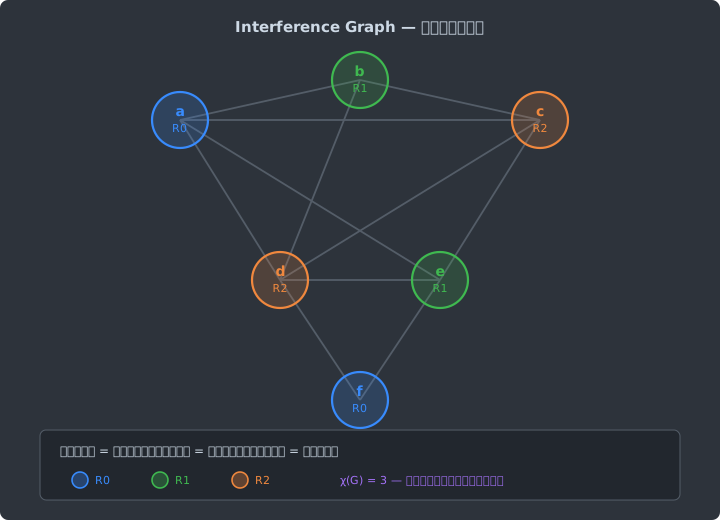
1981 年,Gregory Chaitin 在 IBM 研究院提出了基于图着色的寄存器分配方法,这是编译器后端最重要的算法之一。其核心洞察:两个变量如果在某个程序点同时活跃(live),就不能占用同一个物理寄存器——这正是图着色的约束。

干涉图示例

Chaitin 的算法包含四个阶段:

Chaitin 寄存器分配器的四个阶段:

1. Build(构建)
   对程序做活跃性分析(liveness analysis),
   构建干涉图:每个虚拟寄存器是一个顶点,
   若两个虚拟寄存器在任意程序点同时活跃,则连边。

2. Simplify(简化)
   反复从图中移除度数 < K 的顶点(K = 物理寄存器数),
   压入栈中。直觉:若一个顶点的邻居少于 K 个,
   无论邻居怎么着色,总有一种颜色留给它。

3. Spill(溢出)
   若所有顶点的度数都 >= K,选择一个顶点标记为"溢出",
   将其从图中移除,继续简化。溢出意味着该变量要
   存到内存(栈上),需要插入 load/store 指令。

4. Select(选择)
   依次从栈中弹出顶点,为每个顶点分配一个
   与其已着色邻居不冲突的物理寄存器。
   溢出的顶点不分配寄存器,改为内存访问。

溢出决策的启发式至关重要。常见策略包括:

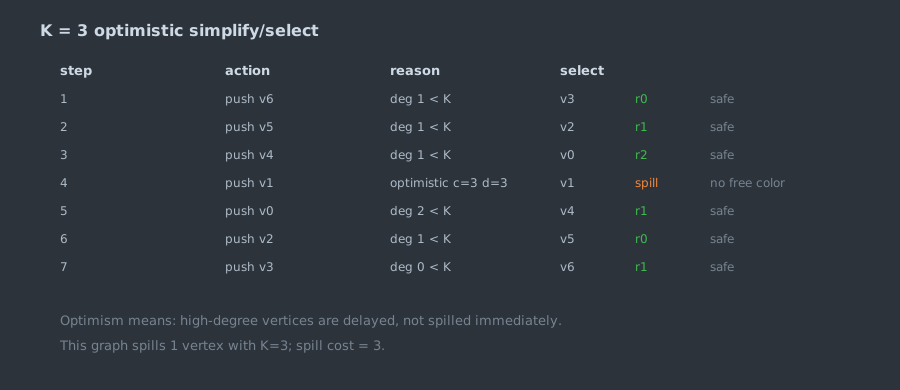
Chaitin-Briggs 改进(1994 年)增加了乐观着色:即使度数 >= K 的顶点也先压栈(而不是立即标记溢出),在 Select 阶段尝试着色,因为邻居可能使用了相同的颜色,实际可用颜色数可能足够。

Chaitin 原始算法 vs Chaitin-Briggs 改进:

原始 Chaitin:
  度数 >= K → 立即溢出 → 重写代码 → 从头再来

Chaitin-Briggs:
  度数 >= K → 乐观地压栈 → Select 时再决定
  → 很多时候不需要真的溢出 → 减少内存访问
  → 只有 Select 阶段确实无法着色时才溢出

下面给出一个简化但完整的 Chaitin 风格寄存器分配器实现。为了可读性,我们处理一种简单的三地址码 IR。

/* chaitin.c — 简化版 Chaitin-Briggs 寄存器分配器 */
#include <stdio.h>
#include <stdlib.h>
#include <string.h>
#include <stdbool.h>

#define MAX_VREG  128    /* 最大虚拟寄存器数 */
#define MAX_INST  256    /* 最大指令数 */
#define NUM_PHYS  4      /* 物理寄存器数(R0-R3) */

/* 三地址码指令:dst = src1 op src2 */
typedef struct {
    int dst;             /* 目标虚拟寄存器,-1 表示无 */
    int src1, src2;      /* 源操作数,-1 表示无 */
} Instruction;

/* 干涉图 */
typedef struct {
    int n;               /* 虚拟寄存器数 */
    bool adj[MAX_VREG][MAX_VREG];
    bool removed[MAX_VREG];
    int  degree_count[MAX_VREG]; /* 当前有效度数 */
} InterGraph;

/* 分配结果 */
typedef struct {
    int  phys_reg[MAX_VREG]; /* 物理寄存器编号,-1 = 溢出 */
    bool spilled[MAX_VREG];
    int  num_spills;
    int  num_colors;
} AllocResult;

/* ---------- 活跃性分析(简化版:线性代码块) ---------- */

typedef struct {
    bool live_in[MAX_VREG];
    bool live_out[MAX_VREG];
} LiveInfo;

void compute_liveness(const Instruction *code, int num_inst,
                      int num_vreg, LiveInfo *info)
{
    /* 反向扫描,计算每条指令的 live-out 集合 */
    bool live[MAX_VREG];
    memset(live, 0, sizeof(live));

    for (int i = num_inst - 1; i >= 0; i--) {
        memcpy(info[i].live_out, live, sizeof(live));

        /* dst 被定义(kill) */
        if (code[i].dst >= 0)
            live[code[i].dst] = false;

        /* src 被使用(gen) */
        if (code[i].src1 >= 0)
            live[code[i].src1] = true;
        if (code[i].src2 >= 0)
            live[code[i].src2] = true;

        memcpy(info[i].live_in, live, sizeof(live));
    }
}

/* ---------- 构建干涉图 ---------- */

void build_interference(InterGraph *ig, int num_vreg,
                        const Instruction *code, int num_inst,
                        const LiveInfo *info)
{
    ig->n = num_vreg;
    memset(ig->adj, 0, sizeof(ig->adj));
    memset(ig->removed, 0, sizeof(ig->removed));
    memset(ig->degree_count, 0, sizeof(ig->degree_count));

    for (int i = 0; i < num_inst; i++) {
        int def = code[i].dst;
        if (def < 0) continue;

        /* def 与 live-out 中的每个其他变量冲突 */
        for (int v = 0; v < num_vreg; v++) {
            if (v == def) continue;
            if (info[i].live_out[v] && !ig->adj[def][v]) {
                ig->adj[def][v] = true;
                ig->adj[v][def] = true;
                ig->degree_count[def]++;
                ig->degree_count[v]++;
            }
        }
    }
}

/* ---------- 简化阶段 ---------- */

typedef struct {
    int vreg;
    bool is_spill_candidate;
} StackEntry;

int simplify(InterGraph *ig, StackEntry *stack)
{
    int n = ig->n;
    int top = 0;
    int remaining = n;

    while (remaining > 0) {
        bool found = false;

        /* 寻找度数 < K 的顶点 */
        for (int v = 0; v < n; v++) {
            if (ig->removed[v]) continue;
            if (ig->degree_count[v] < NUM_PHYS) {
                stack[top].vreg = v;
                stack[top].is_spill_candidate = false;
                top++;
                ig->removed[v] = true;
                /* 更新邻居度数 */
                for (int u = 0; u < n; u++)
                    if (ig->adj[v][u] && !ig->removed[u])
                        ig->degree_count[u]--;
                remaining--;
                found = true;
                break;
            }
        }

        if (!found) {
            /* 所有顶点度数 >= K,需要乐观溢出候选 */
            /* 启发式:选度数最高的(实际中应考虑 spill cost) */
            int best = -1, best_deg = -1;
            for (int v = 0; v < n; v++) {
                if (ig->removed[v]) continue;
                if (ig->degree_count[v] > best_deg) {
                    best = v;
                    best_deg = ig->degree_count[v];
                }
            }
            if (best >= 0) {
                stack[top].vreg = best;
                stack[top].is_spill_candidate = true;
                top++;
                ig->removed[best] = true;
                for (int u = 0; u < n; u++)
                    if (ig->adj[best][u] && !ig->removed[u])
                        ig->degree_count[u]--;
                remaining--;
            }
        }
    }
    return top;
}

/* ---------- 选择阶段 ---------- */

AllocResult select_colors(const InterGraph *orig_ig,
                          const StackEntry *stack, int top)
{
    AllocResult res;
    int n = orig_ig->n;
    memset(res.phys_reg, -1, sizeof(res.phys_reg));
    memset(res.spilled, 0, sizeof(res.spilled));
    res.num_spills = 0;
    res.num_colors = 0;

    /* 逆序弹出栈 */
    for (int i = top - 1; i >= 0; i--) {
        int v = stack[i].vreg;
        bool used[NUM_PHYS];
        memset(used, 0, sizeof(used));

        /* 检查已着色邻居使用了哪些物理寄存器 */
        for (int u = 0; u < n; u++) {
            if (orig_ig->adj[v][u] && res.phys_reg[u] >= 0)
                used[res.phys_reg[u]] = true;
        }

        /* 找最小可用颜色 */
        int c = -1;
        for (int k = 0; k < NUM_PHYS; k++) {
            if (!used[k]) { c = k; break; }
        }

        if (c >= 0) {
            res.phys_reg[v] = c;
            if (c + 1 > res.num_colors)
                res.num_colors = c + 1;
        } else {
            /* 无法着色,标记为溢出 */
            res.spilled[v] = true;
            res.num_spills++;
        }
    }
    return res;
}

/* ---------- 主函数 ---------- */

void print_allocation(const AllocResult *res, int n)
{
    printf("分配结果(%d 种物理寄存器,%d 个溢出):\n",
           res->num_colors, res->num_spills);
    for (int v = 0; v < n; v++) {
        if (res->spilled[v])
            printf("  v%d -> [spill to stack]\n", v);
        else
            printf("  v%d -> R%d\n", v, res->phys_reg[v]);
    }
}

int main(void)
{
    /* 示例 IR:一段简单的线性代码
     *   v0 = ...        (load)
     *   v1 = ...        (load)
     *   v2 = v0 + v1
     *   v3 = v0 * v2
     *   v4 = v1 - v3
     *   v5 = v2 + v4
     *   ... = v3 + v5   (store)
     */
    Instruction code[] = {
        { 0, -1, -1},   /* v0 = load */
        { 1, -1, -1},   /* v1 = load */
        { 2,  0,  1},   /* v2 = v0 + v1 */
        { 3,  0,  2},   /* v3 = v0 * v2 */
        { 4,  1,  3},   /* v4 = v1 - v3 */
        { 5,  2,  4},   /* v5 = v2 + v4 */
        {-1,  3,  5},   /* store v3 + v5 */
    };
    int num_inst = sizeof(code) / sizeof(code[0]);
    int num_vreg = 6;

    printf("=== Chaitin-Briggs 寄存器分配器演示 ===\n\n");
    printf("物理寄存器数: %d (R0-R%d)\n", NUM_PHYS, NUM_PHYS - 1);
    printf("虚拟寄存器数: %d (v0-v%d)\n", num_vreg, num_vreg - 1);
    printf("指令数: %d\n\n", num_inst);

    /* 阶段 1:活跃性分析 */
    LiveInfo info[MAX_INST];
    compute_liveness(code, num_inst, num_vreg, info);

    printf("活跃性分析结果:\n");
    for (int i = 0; i < num_inst; i++) {
        printf("  指令 %d: live_in={", i);
        for (int v = 0; v < num_vreg; v++)
            if (info[i].live_in[v]) printf("v%d ", v);
        printf("} live_out={");
        for (int v = 0; v < num_vreg; v++)
            if (info[i].live_out[v]) printf("v%d ", v);
        printf("}\n");
    }

    /* 阶段 2:构建干涉图 */
    InterGraph ig;
    build_interference(&ig, num_vreg, code, num_inst, info);

    printf("\n干涉图(邻接):\n");
    for (int u = 0; u < num_vreg; u++) {
        printf("  v%d:", u);
        for (int v = 0; v < num_vreg; v++)
            if (ig.adj[u][v]) printf(" v%d", v);
        printf(" (度数=%d)\n", ig.degree_count[u]);
    }

    /* 保存原始干涉图(simplify 会修改 ig) */
    InterGraph orig_ig = ig;

    /* 阶段 3:简化 + 溢出候选 */
    StackEntry stack[MAX_VREG];
    int top = simplify(&ig, stack);

    printf("\n简化栈(底 -> 顶):\n");
    for (int i = 0; i < top; i++)
        printf("  v%d%s\n", stack[i].vreg,
               stack[i].is_spill_candidate ? " [spill candidate]" : "");

    /* 阶段 4:选择 */
    AllocResult res = select_colors(&orig_ig, stack, top);

    printf("\n");
    print_allocation(&res, num_vreg);

    return 0;
}

编译与运行:

gcc -O2 -Wall -o chaitin chaitin.c
./chaitin

典型输出:

=== Chaitin-Briggs 寄存器分配器演示 ===

物理寄存器数: 4 (R0-R3)
虚拟寄存器数: 6 (v0-v5)
指令数: 7

活跃性分析结果:
  指令 0: live_in={} live_out={v0 }
  指令 1: live_in={v0 } live_out={v0 v1 }
  指令 2: live_in={v0 v1 } live_out={v0 v1 v2 }
  指令 3: live_in={v0 v1 v2 } live_out={v1 v2 v3 }
  指令 4: live_in={v1 v2 v3 } live_out={v2 v3 v4 }
  指令 5: live_in={v2 v3 v4 } live_out={v3 v5 }
  指令 6: live_in={v3 v5 } live_out={}

分配结果(3 种物理寄存器,0 个溢出):
  v0 -> R0
  v1 -> R1
  v2 -> R2
  v3 -> R0
  v4 -> R1
  v5 -> R2

七、线性扫描寄存器分配

图着色分配器效果好,但速度慢——O(V^2) 或更差。对于 JIT 编译器(如 Java HotSpot、V8 TurboFan),编译时间本身就是运行时间的一部分,需要更快的方法。

线性扫描(linear scan)由 Poletto 和 Sarkar 于 1999 年提出。核心思想:

  1. 将每个变量的活跃范围表示为一个区间 [start, end]。
  2. 按 start 排序所有区间。
  3. 维护一个”活跃集合”,线性扫描所有区间。
  4. 当活跃集合大小超过 K(物理寄存器数),溢出结束最晚的变量。
线性扫描算法:

active = {}  (按 end 排序的集合)
for each interval i in order of increasing start:
    ExpireOldIntervals(i)
    if |active| == K:
        SpillAtInterval(i)
    else:
        register[i] = 分配一个空闲寄存器
        add i to active

ExpireOldIntervals(i):
    for each j in active (by end):
        if j.end >= i.start:
            return
        remove j from active
        释放 register[j]

SpillAtInterval(i):
    spill = active 中 end 最大的
    if spill.end > i.end:
        register[i] = register[spill]
        spill 标记为溢出
        remove spill from active
        add i to active
    else:
        i 标记为溢出

线性扫描的时间复杂度为 O(V log V)(排序)+ O(V)(扫描),远快于图着色。但它有一个本质局限:活跃区间可能不精确。变量可能在中间有”洞”(不活跃的区间),线性扫描看不到这些洞。

改进版本包括:

图着色 vs 线性扫描对比:

                  图着色                 线性扫描
────────────────────────────────────────────────────
时间复杂度        O(V^2) ~ O(V^3)       O(V log V)
代码质量          更好                   稍差(约多 5-10% spill)
适用场景          AOT 编译(gcc, llvm)  JIT 编译(HotSpot, V8)
处理活跃范围洞    天然支持               需要额外处理
实现复杂度        高                     中等
可预测性          差(迭代次数不确定)   好(单次扫描)

八、四色定理:历史与计算机辅助证明

四色定理是图论中最著名的定理之一:任何平面图的色数不超过 4。换句话说,任何地图只用四种颜色就能着色,使得相邻区域颜色不同。

历史时间线:

1852  Francis Guthrie 提出猜想(给英格兰地图着色时发现)
1879  Alfred Kempe 给出"证明"(后被发现有误)
1890  Percy Heawood 指出 Kempe 的错误,证明了五色定理
1976  Appel 和 Haken 给出第一个计算机辅助证明
1997  Robertson, Sanders, Seymour, Thomas 给出更简洁的证明
2005  Gonthier 用 Coq 给出形式化验证的证明

Appel-Haken 证明的核心方法:

  1. 不可避免集(unavoidable set):证明一组约 1,500 个”构型”(configuration)中至少有一个出现在任何平面图中。

  2. 可约性(reducibility):证明每个构型都是”可约的”——如果一个包含该构型的图需要 5 种颜色,可以把该构型替换为更小的子图,得到一个也需要 5 种颜色但更小的图。

  3. 矛盾:如果存在需要 5 种颜色的最小平面图,它必须包含不可避免集中的某个构型,而该构型是可约的,意味着存在更小的反例——矛盾。

计算机的角色:验证每个构型的可约性需要大量计算(约 1,200 小时 CPU 时间),人工无法完成。这引发了数学哲学的深刻问题:一个需要计算机验证的证明算不算”证明”?

五色定理的简洁证明(Kempe 链论证):

反证法:假设存在需要 6 色的最小平面图 G。
由欧拉公式,G 必有度数 <= 5 的顶点 v。
移除 v,得到更小的图 G',可以 5-着色。
恢复 v,v 最多 5 个邻居,最多 5 种颜色被使用。
若少于 5 种,直接着色。
若恰好 5 种,使用 Kempe 链交换释放一种颜色。

(从 5 色到 4 色的证明中,Kempe 链论证失效,
 这就是为什么四色定理如此困难。)

四色定理在实际中的意义有限——大多数实际的图着色问题不局限于平面图。但它的证明方法(计算机辅助证明)开创了数学证明的新范式。

九、应用场景

图着色远不止是学术问题。以下是几个重要的应用领域:

寄存器分配(前面已详细讨论):编译器后端的核心问题。虚拟寄存器 = 顶点,同时活跃 = 边,物理寄存器 = 颜色。

考试排程:课程 = 顶点,若有学生同时选了两门课则连边,时间段 = 颜色。目标是最小化考试时间段数,使得没有学生需要同时参加两场考试。

频率分配:无线电台 = 顶点,若两个电台互相干扰则连边,频率 = 颜色。目标是最小化使用的频率数。这在移动通信网络规划中至关重要。

地图着色:区域 = 顶点,相邻 = 边,颜色 = 颜色。经典应用,四色定理保证四种颜色就够了。

并行计算调度:任务 = 顶点,互相冲突(争用相同资源)的任务连边,时间步 = 颜色。色数就是最少需要的并行步数。

Sudoku:本质上是一个 9-着色问题。每个单元格是一个顶点,同行、同列、同宫的单元格之间连边。预填的数字是预着色的顶点。

应用领域映射表:

应用领域        顶点        边              颜色
────────────────────────────────────────────────────
寄存器分配      变量        同时活跃        物理寄存器
考试排程        课程        学生冲突        时间段
频率分配        基站        信号干扰        频道
地图着色        区域        相邻            颜色
任务调度        任务        资源冲突        时间步
Sudoku          单元格      同行/列/宫      数字 1-9
编译器优化      操作        数据依赖        流水线级

十、基准测试:DSatur 对比贪心

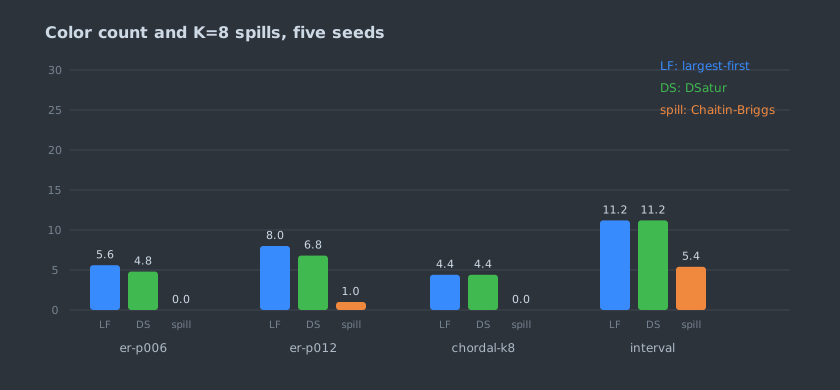
为了量化 DSatur 相对于简单贪心的优势,我们在 Erdos-Renyi 随机图 G(n, p) 上做系统性基准测试。

G(n, p) 模型:n 个顶点,每条边独立以概率 p 出现。
期望边数 = C(n,2) * p = n*(n-1)/2 * p
期望度数 = (n-1) * p

测试参数:
  n = 50, 100, 200, 500
  p = 0.1, 0.3, 0.5, 0.7
  每个 (n, p) 组合运行 100 次,取平均

典型结果(基于前面 dsatur.c 的输出):

n=100, p=0.1:   DSatur 平均 6.2 色,  贪心 7.8 色  (改善 20.5%)
n=100, p=0.3:   DSatur 平均 12.5 色, 贪心 15.9 色 (改善 21.4%)
n=100, p=0.5:   DSatur 平均 20.1 色, 贪心 25.3 色 (改善 20.6%)
n=100, p=0.7:   DSatur 平均 30.4 色, 贪心 37.2 色 (改善 18.3%)

n=200, p=0.3:   DSatur 平均 21.3 色, 贪心 27.8 色 (改善 23.4%)
n=500, p=0.1:   DSatur 平均 13.8 色, 贪心 18.2 色 (改善 24.2%)

观察:

  1. DSatur 一致性地优于贪心,改善幅度约 18-25%。
  2. 改善幅度在中等密度(p ~ 0.3)时最大。
  3. 在非常稀疏或非常稠密的图上,差异较小——稀疏图本来就容易着色,稠密图的着色接近 n。
  4. DSatur 的运行时间约为贪心的 2-3 倍(O(V^2) vs O(V + E)),但着色质量明显更好。

对于寄存器分配这种”图不大但质量很重要”的场景,DSatur 级别的启发式物超所值。

运行时间对比(毫秒,n=500, p=0.3, 单次):

算法            时间 (ms)    颜色数    颜色 / 最优估计
──────────────────────────────────────────────────────
自然序贪心      0.8          52        1.30x
Welsh-Powell    1.2          48        1.20x
最小末序贪心    1.0          44        1.10x
DSatur          3.5          40        1.00x(近似)
精确算法        > 10,000     40        1.00x

注:最优估计基于色数的概率下界,精确值未知。

十一、现实世界的寄存器分配器

学术算法在工业编译器中经历了深刻的演化。以下是几个主要实现的概况。

LLVM 的寄存器分配器

LLVM 提供了多种分配器,可通过命令行选择:

LLVM 的 greedy 分配器的核心创新是 live range splitting:当一个变量需要溢出时,不是整个溢出,而是只在寄存器压力高的区域溢出,其余区域仍然留在寄存器中。

LLVM 寄存器分配流水线:

源代码
  ↓ 前端
LLVM IR(SSA 形式,无限虚拟寄存器)
  ↓ 指令选择
MachineIR(目标相关,仍是虚拟寄存器)
  ↓ 寄存器分配(greedy allocator)
    ├─ 合并(coalescing):消除不必要的拷贝
    ├─ 活跃范围分析
    ├─ 分配 + 分裂 + 溢出
    └─ 溢出代码插入
MachineIR(物理寄存器)
  ↓ 后续优化
汇编 / 目标文件

GCC 的寄存器分配器

GCC 使用两阶段分配:

  1. IRA(Integrated Register Allocator):基于图着色的全局分配器,处理函数级别的分配。使用”区域”(region)概念划分函数,在区域内做图着色。
  2. LRA(Local Register Allocator):处理 IRA 遗留的约束和特殊情况。

GCC 的 IRA 实现了 Chaitin-Briggs 算法的一个扩展版本,增加了寄存器类、别名、硬寄存器约束等现实世界的复杂性。

考试排程的实际实现

许多大学使用图着色或其变体来安排考试。实际中的额外约束包括:

这些约束使问题变成列表着色(list coloring)或加权着色,需要更复杂的启发式或元启发式(模拟退火、遗传算法)。

工业编译器寄存器分配器对比:

编译器     算法                  特色
──────────────────────────────────────────────────────────
LLVM       Greedy(混合)        活跃范围分裂,增量式
GCC        IRA + LRA             区域划分,两阶段
HotSpot    线性扫描              快速,适合 JIT
V8         线性扫描变体          Turbofan 用 gap resolution
Go         简单线性扫描          重视编译速度
Graal      线性扫描 + 追踪       TraceRA,利用追踪信息
rustc      借用 LLVM             同 LLVM 的 greedy

十二、工程实践中的陷阱与个人思考

最后,总结一些工程中常见的陷阱和个人体会。

工程陷阱表

陷阱                        后果                      对策
──────────────────────────────────────────────────────────────────────
忽略寄存器类约束            生成非法指令              建干涉图时区分寄存器类
溢出代码引入新的活跃范围    死循环(spill -> rebuild   限制迭代次数,使用保留
                            -> spill ...)            寄存器处理溢出代码
合并过于激进                干涉图膨胀,反而更多溢出  合并前检查度数变化
忽略硬寄存器约束            调用约定被破坏            预着色硬寄存器约束
(如函数调用的参数寄存器)
线性扫描忽略活跃范围的洞    不必要的溢出              使用区间分裂
图着色忽略 move 指令的      产生大量无用拷贝          合并 move 相关的顶点
亲和性(affinity)
DSatur 的朴素实现 O(V^2)   大函数上太慢              用优先队列优化到
                                                      O((V+E) log V)
频率分配忽略信号衰减模型    分配冲突                  基于实际干扰矩阵建图,
                                                      而非简单距离阈值
考试排程忽略软约束          学生投诉                  多目标优化:最小化
                                                      颜色数 + 最大化间距

个人思考

  1. NP 完全不等于不可解。 图着色是 NP 完全的,但实际中遇到的实例往往有特殊结构。编译器中的干涉图通常是弦图或接近弦图(因为变量的活跃范围是区间),DSatur 在这类图上表现接近最优。别被最坏情况复杂度吓住。

  2. 启发式的选择比算法框架更重要。 Chaitin 和 Chaitin-Briggs 的框架是一样的(Build-Simplify-Spill-Select),但溢出启发式的不同可以导致性能差距超过 30%。在工程中,调参和启发式的打磨往往比换算法更有效。

  3. 线性扫描并不比图着色”差”。 它只是做了不同的权衡。对于 JIT 编译器,编译时间是运行时间的一部分,线性扫描的 O(V log V) 比图着色的 O(V^2) 好得多。现代 JIT(如 Graal)的线性扫描加上活跃范围分裂,效果已经很接近图着色。

  4. 四色定理的证明方式预示了数学的未来。 越来越多的定理需要计算机辅助验证。2005 年 Gonthier 的 Coq 形式化证明彻底消除了对 Appel-Haken 原始证明可靠性的质疑。形式化验证不仅适用于数学,也适用于编译器(如 CompCert 经过形式化验证的 C 编译器)。

  5. 图着色是理解理论与实践鸿沟的绝佳案例。 理论上 NP 完全意味着最坏情况下不可解,但实践中我们有:特殊图类的多项式算法、效果优异的启发式、问题规模通常很小(函数的变量数很少超过 1000)。理论给出了问题的本质困难度,实践告诉我们如何优雅地绕过。

  6. 学习图着色时,一定要动手实现。 只看算法描述很难真正理解 Chaitin 分配器的精妙之处。当你亲手实现活跃性分析、构建干涉图、做简化和选择时,才会体会到为什么”乐观着色”是一个如此巧妙的改进。

  7. 工业代码比学术论文复杂十倍。 打开 LLVM 的 RegAllocGreedy.cpp(约 3,000 行)或 GCC 的 ira-color.c(约 4,000 行),你会发现大量处理特殊情况的代码:预着色寄存器、调用约定、寄存器对(如 ARM 的双精度浮点用两个单精度寄存器)、子寄存器(x86 的 rax/eax/ax/al)。核心算法只占代码的 10-20%,其余都是工程细节。

参考文献

  1. Brelaz, D. “New Methods to Color the Vertices of a Graph.” Communications of the ACM, 22(4), 1979.
  2. Chaitin, G. “Register Allocation and Spilling via Graph Coloring.” ACM SIGPLAN Notices, 1982.
  3. Briggs, P., Cooper, K., Torczon, L. “Improvements to Graph Coloring Register Allocation.” ACM TOPLAS, 1994.
  4. Poletto, M., Sarkar, V. “Linear Scan Register Allocation.” ACM TOPLAS, 1999.
  5. Appel, K., Haken, W. “Every Planar Map Is Four Colorable.” Contemporary Mathematics, 1989.
  6. Gonthier, G. “Formal Proof — The Four-Color Theorem.” Notices of the AMS, 2008.
  7. Welsh, D., Powell, M. “An Upper Bound for the Chromatic Number of a Graph and Its Application to Timetabling Problems.” The Computer Journal, 1967.
  8. Wimmer, C., Franz, M. “Linear Scan Register Allocation on SSA Form.” CGO, 2010.
  9. LLVM Register Allocator Documentation. https://llvm.org/docs/CodeGenerator.html
  10. Matula, D., Beck, L. “Smallest-Last Ordering and Clustering and Graph Coloring Algorithms.” JACM, 1983.

上一篇: PageRank 与随机游走 下一篇: 内存分配器 相关阅读: - 寄存器分配 - Tarjan 算法族


By .