“保留每一个历史版本”听上去意味着每次修改都要整体复制。实际上,一棵 \(2^{20}\) 个键的持久化 AVL 树插入一个键,只新增约 21 个节点;一个 \(2^{20}\) 个元素的 32 路持久化向量改一个元素,只新分配 1056 字节,而整份数组是 8 MiB(第二节、第五节的实测)。关于这类结构,流传着几种不准确的说法:Clojure 的向量”就是 HAMT”;32 路分支让更新”实际上是 \(O(1)\)“;Driscoll 等人证明了”胖节点只要 \(O(1)\) 均摊空间”;Git “就是路径复制”。每一句都有一部分对。
本文按”定义 → 路径复制 → DSST 的通用变换 →
纯函数式实现与均摊分析 → 宽分支 trie → HAMT/CHAMP → Git →
工程问题 → 争论”的顺序展开。数字来自同目录
reproduce/ 下的程序,源码以 Clojure
1.12.6、Scala 2.13.18 为准。同主题的旧文 记录历史:持久化数据结构
详细推演过节点复制在链表上的例子,本文不重复。
一、定义:部分、完全与汇合持久化
普通数据结构是短暂的(ephemeral):一次修改破坏旧版本,只留下新版本。Driscoll、Sarnak、Sleator 和 Tarjan(下文简称 DSST)在 1989 年的 JCSS 论文里给出了沿用至今的定义:
- 部分持久化(partial persistence):所有版本都能读,只有最新版本能改;
- 完全持久化(full persistence):任何版本都能读、都能改;
- 论文第 6 节把”用两个以上旧版本组合出新版本”(例如拼接两个列表)列为开放问题 (ii)。后来这种能力被称为汇合持久化(confluent persistence),Driscoll、Sleator、Tarjan(JACM 1994)的可拼接持久化列表和 Fiat、Kaplan(J. Algorithms 2003)的通用变换是这条线上的代表工作。
三者的区别在版本图的形状上:
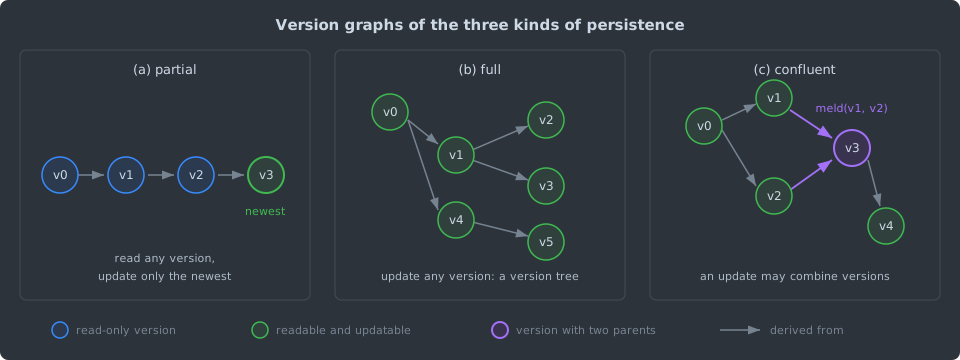
- 部分持久化的版本是全序的,版本号可以直接用整数比较,查旧版本时”找不超过 \(v\) 的最大时间戳”就够了。
- 完全持久化的版本是一棵树,两个版本可能不可比较。DSST 用版本树的先序列表加上顺序维护结构(order maintenance,Dietz & Sleator,STOC 1987)来比较版本先后。
- 汇合持久化的版本图是 DAG,一个版本可以有两个父版本。难点在于合并后逻辑规模可以指数增长:把一个长度为 \(n\) 的列表与自身拼接 \(k\) 次,得到长度 \(2^k n\) 的列表,只能靠共享才能用多项式空间表示。
函数式语言里常说的纯函数式数据结构(purely functional data structure)是一种实现约束:节点一旦构造就不再修改。满足这个约束的结构自动是完全持久化的;如果操作本身接受两个结构作参数(比如拼接),也就自然支持汇合式的使用,但代价界要单独分析。
二、路径复制:复制搜索路径
机制
路径复制(path copying)是最直接的做法:修改一个节点时,把从根到它的整条路径复制一遍,路径之外的子树直接共享。DSST 第 4 节把这种方法归于 Myers(“AVL dags”,1982;POPL 1984)、Krijnen 与 Meertens、Reps、Teitelbaum 与 Demers,以及 Swart 的独立工作,并不是 DSST 自己提出的。
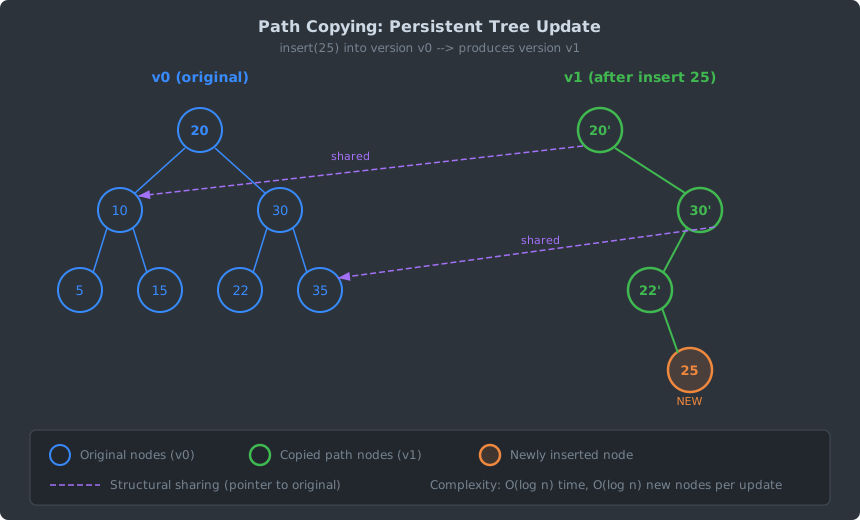
图里的 v1 由 4 个新节点组成:3 个路径副本加 1 个新叶子。20’ 的左子树、30’ 的右子树都是 v0 中原有的节点。v0 的任何节点都没有被写过,所以读 v0 的线程不需要加锁,也看不到”改了一半”的状态。
对平衡树,旋转只涉及路径上的节点和它们的兄弟,所以每次更新新增
\(O(\log n)\)
个节点。下面是 reproduce/pavl.c
中插入与再平衡的核心部分(省略了引用计数的定义和删除)。每个返回
Node *
的函数都返回一个”自有引用”,与旧版本共享的子树用
retain() 加一次引用计数:
/* reproduce/pavl.c:持久化 AVL 的插入,节选 */
static Node *balance(int key, Node *l, Node *r)   /* takes ownership of l, r */
{
    int hl = height(l), hr = height(r);
    if (hl > hr + 1) {
        Node *res;
        if (height(l->left) >= height(l->right)) {       /* single right rotation */
            res = mk(l->key, retain(l->left), mk(key, retain(l->right), r));
        } else {                                          /* left-right */
            Node *lr = l->right;
            res = mk(lr->key, mk(l->key, retain(l->left), retain(lr->left)),
                     mk(key, retain(lr->right), r));
        }
        release(l);
        return res;
    }
    /* hr > hl + 1 is symmetric */
    ...
    return mk(key, l, r);
}

static Node *ins(const Node *t, int key)
{
    if (!t) return mk(key, NULL, NULL);
    if (key < t->key) return balance(t->key, ins(t->left, key), retain(t->right));
    return balance(t->key, retain(t->left), ins(t->right, key));
}
旋转时原先的 l
往往是这次刚复制出来的节点,release(l)
会立刻释放它,所以”分配的节点数”略多于”新版本实际保留的节点数”。
实测:每次更新新增多少节点
实验环境(本文所有自测数据相同):Intel Core
i9-12900K,WSL2 内核 6.6.87.2,GCC 16.1.1,Python
3.14.5。pavl measure 先按随机顺序插入 \(n\)
个偶数键,再在这个基础版本上各做 20,000
次”插入一个不存在的奇数键”和”删除一个存在的键”,每次操作后立即释放新版本。计数与时钟无关,固定种子下重复运行输出逐字节一致。
| \(n\) | \(\lfloor\log_2 n\rfloor\) | 树高 | 插入:分配节点 | 插入:新版本保留节点 | 删除:保留节点 |
|---|---|---|---|---|---|
| 1,024 | 10 | 12 | 11.88 | 11.21 | 9.54 |
| 16,384 | 14 | 17 | 15.96 | 15.27 | 13.54 |
| 262,144 | 18 | 22 | 20.05 | 19.35 | 17.67 |
| 1,048,576 | 20 | 24 | 22.05 | 21.36 | 19.62 |
每次插入保留的节点数约为 \(\log_2 n +
1.3\),与一条从根到插入点的路径长度相当。插入引起的旋转只重排路径上已经复制过的节点,不增加副本;删除引起的旋转发生在另一侧,要额外复制兄弟节点;但被删节点本身不再出现在新版本里,插入则要多出一个新叶子,所以删除保留的节点反而比插入少约
1.7 个。pavl.c 中每个节点 32 字节,\(n = 2^{20}\) 时一个新版本约多占
\(21.36 \times 32 \approx
684\) 字节。
pavl test 做了另一件事:从 4000
个版本里随机挑一个旧版本继续插入或删除(完全持久化的用法),所有版本一直保留,最后逐个版本、逐个键与朴素的位图副本对照,共
8,192,000
次成员查询全部一致;随后释放所有版本,存活节点数回到
0。编译参数为 -O2 -Wall -Wextra,另用
-fsanitize=address,undefined 跑过一遍。
路径复制的前提
路径复制要求”从根能走到每个节点,且路径唯一”。有父指针的结构不适用:改一个叶子,就要改它父亲的子指针,而父亲又被所有孩子的父指针指着,复制会沿父指针扩散到整棵树。双向链表、带父指针的红黑树(例如
Linux rbtree 的
__rb_parent_color)都属于这种情况,要么改写成不带父指针的递归版本,要么换用下一节的节点复制。
三、DSST 1989:胖节点、节点复制与节点分裂
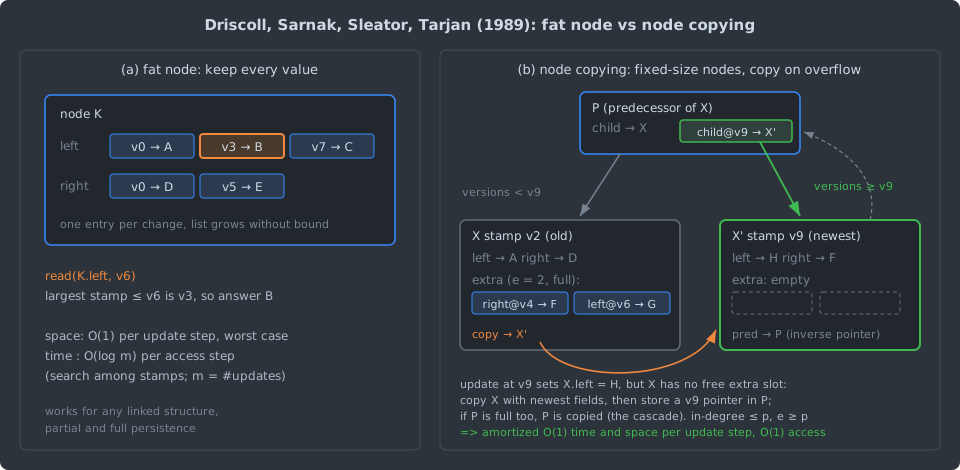
DSST 的目标是一个通用变换:给定任意链式(pointer-based)短暂结构,把它的每一步访问和修改模拟到一个持久化结构上,理想情况下每个更新步只多花 \(O(1)\) 空间,每个访问步只慢常数倍。论文给出三种方法,前两种见下图:
胖节点
胖节点(fat node)方法让每个节点保存每个字段的全部历史取值,每个取值带一个版本戳。修改不覆盖旧值,只追加一条记录;读版本 \(i\) 的字段时,取版本戳不超过 \(i\) 的最新记录。
- 每个更新步只追加一条记录,最坏情况 \(O(1)\) 空间(不是均摊);
- 每个字段的记录按版本戳放在一棵搜索树里,每个访问步和更新步要 \(O(\log m)\) 时间,\(m\) 是更新次数(DSST 第 2.2 节);
- 适用于任何链式结构;做完全持久化时,版本戳之间要用版本树的顺序比较,界不变(第 3.2 节)。
代价是对数级的访问减速,以及”节点大小不固定”:胖节点在实现上要拆成若干固定大小节点的链表。
节点复制
节点复制(node copying)去掉了这两个缺点,前提是短暂结构中每个节点的入度有常数上界 \(p\)(任一版本中指向它的指针不超过 \(p\) 个)。设节点有 \(d\) 个指针字段,每个持久化节点有 \(d + p + e + 1\) 个指针槽位:\(d\) 个原始字段,\(p\) 个逆指针(记录谁指向自己),\(e\) 个带版本戳的额外槽位,1 个指向自己副本的 copy 指针(论文第 2.3.1 节)。
修改指针字段时,如果节点还有空的额外槽位,就把”字段名、版本戳、新值”写进去;槽位满了,就复制出一个只含最新值的新节点,并通过逆指针找到所有前驱,在前驱里记下指向新副本的指针。前驱的额外槽位也可能满了,于是复制会级联。
级联复制为什么只摊到 \(O(1)\)?DSST 取势函数
\[ \Phi = \frac{e}{e-p+1}\, L \;-\; \frac{1}{e-p+1}\, U, \]
其中 \(L\) 是存活节点数,\(U\) 是存活节点中空闲额外槽位的总数。复制一个节点,满节点死去、新节点槽位全空,势能下降 \(\frac{e}{e-p+1}\);往额外槽位里写一个指针,势能上升 \(\frac{1}{e-p+1}\)。一次更新操作开始级联时有 \(t\) 个待处理的已复制节点,级联中又复制了 \(k\) 个,每个被处理的节点最多往前驱写 \(p\) 个指针,其中至少 \(k\) 个写进了新副本的原始字段而不占额外槽位。于是级联阶段的均摊空间为
\[ k + \frac{p(t+k) - k}{e-p+1} - \frac{k\,e}{e-p+1} = \frac{p\,t}{e-p+1} = O(t), \]
\(k\) 被完全抵消。只要取 \(e \ge p\),每个更新步的均摊时间和空间都是 \(O(1)\),每个访问步是最坏 \(O(1)\)(论文第 2.3.4 节)。
节点分裂与平衡树
完全持久化下,一个节点的修改记录属于版本树的不同分支,不能简单地”复制最新值”。DSST 第 3.3 节的节点分裂(node splitting)借鉴了 B 树的分裂:节点溢出时,按版本树把记录分成两半放进两个节点。结论与节点复制相同:入度有界时,每个更新步均摊 \(O(1)\) 时间与空间,每个访问步最坏 \(O(1)\)。
把这些方法用到红黑树上,关键在于红黑树的一次插入最多两次旋转、一次删除最多三次旋转,重新着色的均摊次数是 \(O(1)\);搜索路径上的节点只被访问,不被修改。DSST 第 4.1 节的部分持久化红黑树只给每个节点一个额外指针(\(e = 1\));由于每个节点只有一条访问路径,连逆指针都不需要;颜色不参与访问,旧颜色可以直接覆盖。结果是每次插入或删除最坏 \(O(\log n)\) 时间,\(m\) 次更新共 \(O(m)\) 空间。
完全持久化时出现了一个与第四节同源的问题:重新着色只是均摊 \(O(1)\),而同一个旧版本可以被反复更新,均摊不再成立,节点分裂需要的是每次更新最坏 \(O(1)\) 次修改。第 4.2 节借用 Tsakalidis 的延迟重新着色(lazy recoloring)满足了这一点,得到均摊 \(O(1)\) 空间的完全持久化红黑树;第 5 节再用”位移存储”(displaced storage)把空间界改成最坏 \(O(1)\)。论文明确对比:路径复制每次插入或删除最坏需要 \(O(\log n)\) 空间,他们的方法”节省了一个对数因子”。
| 方法 | 前提 | 持久化类型 | 每个更新步的空间 | 每个访问步的时间 | 出处 |
|---|---|---|---|---|---|
| 路径复制 | 树形、无父指针 | 完全 | 平衡树每次更新最坏 \(O(\log n)\) | 不变 | Myers 1982/1984 等,DSST 第 4 节 |
| 胖节点 | 任意链式结构 | 部分、完全 | 最坏 \(O(1)\) | \(O(\log m)\) | DSST 第 2.2、3.2 节 |
| 节点复制 | 入度 \(\le p\) | 部分 | 均摊 \(O(1)\) | 最坏 \(O(1)\) | DSST 第 2.3 节 |
| 节点分裂 | 入度 \(\le p\) | 完全 | 均摊 \(O(1)\) | 最坏 \(O(1)\) | DSST 第 3.3 节 |
| Brodal 的节点复制 | 入度、出度都有界 | 部分 | 最坏 \(O(1)\) | 最坏 \(O(1)\) | Brodal,BRICS RS-94-35 |
最后一行回答了 DSST 开放问题 (i) 的部分持久化情形:Brodal 用 Dietz 和 Raman 的双人卵石博弈策略,把节点复制的更新代价从均摊 \(O(1)\) 改进为指针机模型下的最坏 \(O(1)\)。
部分持久化最早的杀手级应用是平面点定位。Sarnak 和 Tarjan(CACM 1986)用一条竖直扫描线从左到右扫过平面剖分,扫描线与线段的上下顺序存在一棵搜索树里,每经过一个端点就在最新版本上插入或删除一条线段;查询点 \((x, y)\) 时,先按 \(x\) 找到对应版本,再在该版本里按 \(y\) 查找。用 \(O(1)\) 均摊空间的持久化搜索树,得到 \(O(\log n)\) 查询、\(O(n)\) 空间、\(O(n \log n)\) 预处理。站内 线段树与树状数组 第九节的选型表把”查询历史版本”交给可持久化线段树,它就是对线段树做路径复制:每次单点修改复制根到叶的 \(O(\log n)\) 个节点。
四、纯函数式实现:Okasaki 与持久化下的均摊
不修改节点,持久化自动成立
在 Haskell、ML
这类语言里,构造器只能新建节点,不能改写已有节点,路径复制是语言的默认行为。Okasaki
在 JFP 1999 的函数式珍珠(Functional Pearl)“Red-black trees
in a functional setting”
中把红黑树插入的四种失衡情况合并成一个 balance
函数。下面的 Haskell 片段按论文整理,本站没有编译运行:
data Color = R | B
data Tree a = E | T Color (Tree a) a (Tree a)

balance :: Color -> Tree a -> a -> Tree a -> Tree a
balance B (T R (T R a x b) y c) z d = T R (T B a x b) y (T B c z d)
balance B (T R a x (T R b y c)) z d = T R (T B a x b) y (T B c z d)
balance B a x (T R (T R b y c) z d) = T R (T B a x b) y (T B c z d)
balance B a x (T R b y (T R c z d)) = T R (T B a x b) y (T B c z d)
balance color a x b = T color a x b
模式匹配右侧的每个 T
都是一次新节点分配,左侧匹配到的子树
a、b、c、d
原样共享,这就是路径复制。删除要难得多,Okasaki
的珍珠没有给出;Kahrs(JFP
2001)给出了带类型不变量的删除,Germane 和 Might(JFP
2014)的 “Deletion: The curse of the red-black tree”
用临时的”双黑”颜色给出了另一种写法。
均摊分析在持久化下失效
均摊界假设操作序列是线性的:昂贵操作的代价由之前的廉价操作”预付”。持久化打破了这个假设,同一个旧版本可以被反复使用,预付的钱只能花一次,昂贵操作却可以执行很多次。
经典例子是两个列表实现的批量队列(batched queue):前端列表 \(f\) 出队,后端列表 \(r\) 入队,\(f\) 空时把 \(r\) 翻转成新的 \(f\)。短暂使用时每次操作均摊 \(O(1)\)。持久化使用时,构造一个”\(f\) 只剩一个元素、\(r\) 有 \(n-1\) 个元素”的版本,然后对同一个版本反复出队,每次都要重新翻转 \(r\)。
reproduce/queue_amort.py
用抽象步数计量(新建一个 cons 单元或求值一个挂起计算记 1
步),\(n =
100{,}000\):
| 队列 | 短暂使用:\(n\) 次入队再 \(n\) 次出队的总步数 | 短暂使用:单次操作最大步数 | 对同一版本出队 1000 次的总步数 | 单次最大步数 |
|---|---|---|---|---|
| 批量队列 | 200,000 | 99,999 | 99,999,000 | 99,999 |
| 实时队列 | 200,000 | 2 | 0 | 0 |
批量队列在短暂使用下每次操作平均 1 步,符合均摊 \(O(1)\);换成持久化用法后,1000
次出队花了 \(1000 \times
(n-1)\) 步。\(n =
1000\)、\(10{,}000\)
的结果规律相同,见
reproduce/results/queue_amort.txt。
惰性求值与调度
Okasaki 的解决办法有两层。第一层是惰性求值加记忆化:把昂贵的翻转包成一个挂起计算(suspension),第一次求值后缓存结果。同一个旧版本被反复使用时,共享的是同一个挂起计算,翻转只真正执行一次,均摊界得以恢复。他的书用”借记”(debit)而不是”信用”(credit)来做这类分析:只要证明每个挂起计算在被强制求值之前,其代价已经分摊到足够多的操作上。
第二层是把均摊界变成最坏界:实时队列(Okasaki,JFP
1995)。它把 \(f\)
做成惰性流,维护一个指向 \(f\) 内部的指针 \(s\),每次操作顺手强制求值 \(s\) 的一个单元,不变量是 \(|s| = |f| - |r|\)。当 \(s\) 走到头,恰好 \(|r| = |f| +
1\),此时启动一次惰性的 rotate,把
“\(f\) 接上 \(r\) 的逆序”
表示成逐单元求值的流。Hood 和 Melville(IPL
1981)更早给出过纯 Lisp
的实时队列,用的是显式的增量翻转;Okasaki
的版本靠惰性求值把这套簿记隐藏起来。复现程序中的核心部分如下:
# reproduce/queue_amort.py:Okasaki 实时队列,节选
def rotate(f, r, a):
    """lazy f ++ reverse r ++ a, one step per forced cell; requires |r| = |f| + 1"""
    def step():
        tick()
        fv = f.force()
        y, r2 = r
        if fv is None:
            return (y, a)
        x, f2 = fv
        return (x, rotate(f2, r2, Susp(val=(y, a), done=True)))
    return Susp(step)


def rq_exec(f, r, s):
    sv = s.force()                 # pay for one suspended step
    if sv is not None:
        return (f, r, sv[1])
    f2 = rotate(f, r, NIL)         # |r| = |f| + 1: start a new rotation
    return (f2, None, f2)
上表里实时队列单次操作最多 2
步,与版本如何被复用无关;持久化出队 1000 次总共 0 步(\(n = 10{,}000\) 时是 1
步),是因为构造这个版本的过程中 \(f\) 的首个单元通常已经被 \(s\)
求值过,之后只是读缓存;即使没有,也只在第一次出队时求值一次,其余
999
次共享记忆化的结果。两种队列都通过了随机持久化用法的对照测试:20,000
次操作各自随机挑一个旧版本入队或出队,与 Python
deque 副本逐一比较。
同一思路推到更复杂的结构,Kaplan 和 Tarjan(JACM 1999)用”递归减速”(recursive slow-down)得到了纯函数式、支持拼接、所有操作最坏 \(O(1)\) 的双端队列。
五、宽分支 trie:Clojure 的 PersistentVector
结构
二叉树上的路径复制每次要复制约 \(\log_2 n\)
个节点,读一个元素也要走 \(\log_2
n\) 步指针。Clojure 的 PersistentVector
把分支因子加大到
32:它是一棵按下标的二进制位切分的
trie(bit-partitioned trie),每层消耗下标的 5
位。它不是 HAMT,里面没有哈希,HAMT 是
PersistentHashMap 的结构(第六节)。clojure.org
的数据结构文档对复杂度的表述是”access to items by index in
log32N hops”。
以 Clojure 1.12.6 的
src/jvm/clojure/lang/PersistentVector.java
为准,一个向量由四个字段组成:元素个数
cnt、根所在层的位移 shift、根节点
root、以及单独存放的尾数组
tail。内部节点 Node 就是一个 32
格的 Object[] 加一个 edit
标记(transient 用,见下文)。空向量的 shift 是
5。
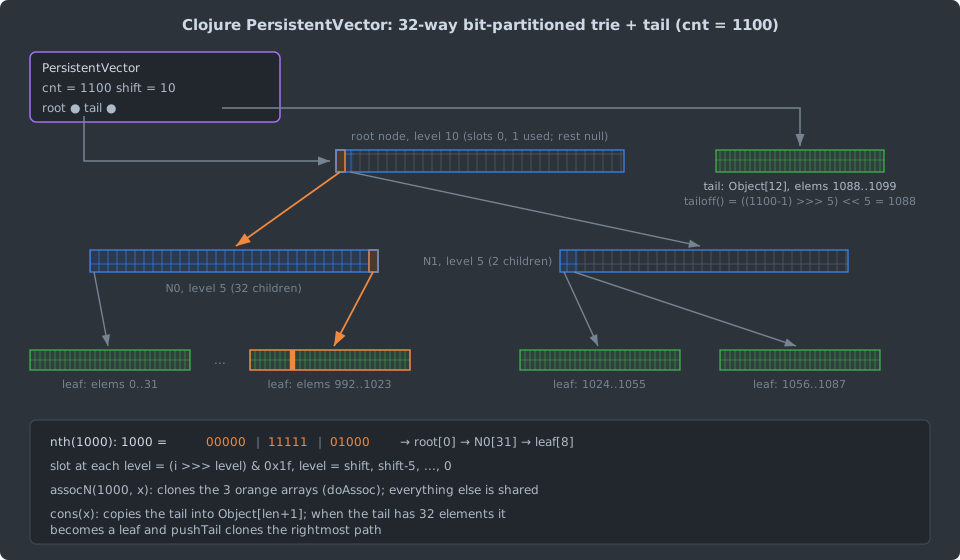
tailoff()是 tail 之前的元素个数,等于((cnt - 1) >>> 5) << 5。图中 \(\mathrm{tailoff} = 1088\),下标不小于它的元素直接在 tail 里,不走树。- 下标 \(i\) 在第
level层的槽位是(i >>> level) & 0x1f,level从shift每次减 5 直到 0。\(1000 = 00000\,11111\,01000_2\),所以路径是 0、31、8。 - 根只有在装满时才长高:
cons里的判断是(cnt >>> 5) > (1 << shift),此时新建一个根,旧根放进 0 号槽,1 号槽挂一条新路径。
查找与更新的源码(Clojure
1.12.6,PersistentVector.java,未删减):
final int tailoff(){
    if(cnt < 32)
        return 0;
    return ((cnt - 1) >>> 5) << 5;
}

public Object[] arrayFor(int i){
    if(i >= 0 && i < cnt)
        {
        if(i >= tailoff())
            return tail;
        Node node = root;
        for(int level = shift; level > 0; level -= 5)
            node = (Node) node.array[(i >>> level) & 0x01f];
        return node.array;
        }
    throw new IndexOutOfBoundsException();
}

private static Node doAssoc(int level, Node node, int i, Object val){
    Node ret = new Node(node.edit,node.array.clone());
    if(level == 0)
        {
        ret.array[i & 0x01f] = val;
        }
    else
        {
        int subidx = (i >>> level) & 0x01f;
        ret.array[subidx] = doAssoc(level - 5, (Node) node.array[subidx], i, val);
        }
    return ret;
}
doAssoc 就是第二节的路径复制,每层
clone() 一个 32 格数组。
“实际上是常数”的真实含义
树高是 \(\lceil \log_{32} n
\rceil\) 量级,不是常数。它看上去像常数,是因为 Java
的下标是 32 位 int:\(32^6 = 2^{30} \approx 1.07 \times
10^9\),所以 10 亿个元素的向量有 6
层,int 能表示的最大向量也只需要 7 层。每次
assocN 复制的是”层数 \(\times\) 32 个引用”,这是 \(O(\log n)\)
乘上一个不小的常数。
tail 与追加
持久化的 cons(追加)有两种情况:
- tail
未满(
cnt - tailoff() < 32):新建一个长度加 1 的数组,把旧 tail 整个复制过去再写入新元素。持久化版本每次追加都复制 tail,不是”在 tail 末尾写一格”。 - tail 已满:旧 tail 原样变成一个叶子,由
pushTail复制最右侧路径挂进树里;新 tail 是只含新元素的 1 格数组。
所以追加 32 个元素要复制 \(1 + 2 + \cdots + 32 = 528\) 个引用,外加一次最右路径复制。tail 的好处是不碰树:31/32 的追加只分配一个小数组,而且最近追加的元素读取时不用走树。
“在 tail 末尾原地写一格”是 TransientVector
的行为。(transient v) 生成一个带新
edit 令牌的可变视图:conj 直接写
32 格的 tail,ensureEditable(node) 只在节点的
edit 不是自己的令牌时才克隆,于是同一个
transient
内的连续修改不会反复复制同一个节点;persistent!
把令牌置空,此后再修改该 transient 会抛
IllegalAccessError,并把 tail
裁剪到实际长度。1.12.6 的 persistent()
里,检查调用线程是否为所有者的代码已被注释掉。
实测:分支因子的取舍
reproduce/pvec.c 按 Clojure
的布局实现了同样的 trie(含
tail、pushTail、根溢出),但分支因子 \(W = 2^B\) 可调。节点大小为 8
字节头加 \(W\) 个 8
字节槽,tail 按实际长度分配。\(n =
2^{20}\) 个 8 字节元素,整份数组是 8,388,608
字节:
| \(W\) | 层数 | 每次 assoc 分配字节 |
每次追加平均分配字节 | 整个向量字节/元素 |
|---|---|---|---|---|
| 2 | 20 | 480 | 236.0 | 24.00 |
| 4 | 10 | 400 | 114.7 | 13.33 |
| 8 | 7 | 504 | 95.4 | 10.29 |
| 16 | 5 | 680 | 109.4 | 9.07 |
| 32 | 4 | 1,056 | 164.5 | 8.52 |
| 64 | 4 | 2,080 | 290.3 | 8.25 |
每次 assoc 的字节数严格等于”层数 \(\times (8 + 8W)\)“,例如 \(W = 32\) 时 \(4 \times 264 =
1056\)。更新代价的最小值在 \(W = 4\),\(W = 32\) 是它的 2.6 倍;但
\(W = 32\)
的整体空间开销只有 6.5%(8.52 字节存一个 8 字节元素),\(W = 2\) 要 3
倍。追加的平均代价在 \(W =
8\) 最低,\(W = 32\)
时主要花在 tail 的逐次复制上:每 32 次追加复制 528 个槽,约
\(528 \times 8 / 32 = 132\)
字节,再加上 tail 数组头和每 32
次一次的最右路径复制,与实测的 164.5 字节一致。
读的一侧用随机下标读 \(10^7\)
次计时,taskset -c 15 绑核,每次运行取 5
轮中位数,共独立运行 3
次。机器上同时有其他负载,同一配置在三次运行之间相差可达 2
倍,所以下图右侧只看趋势:
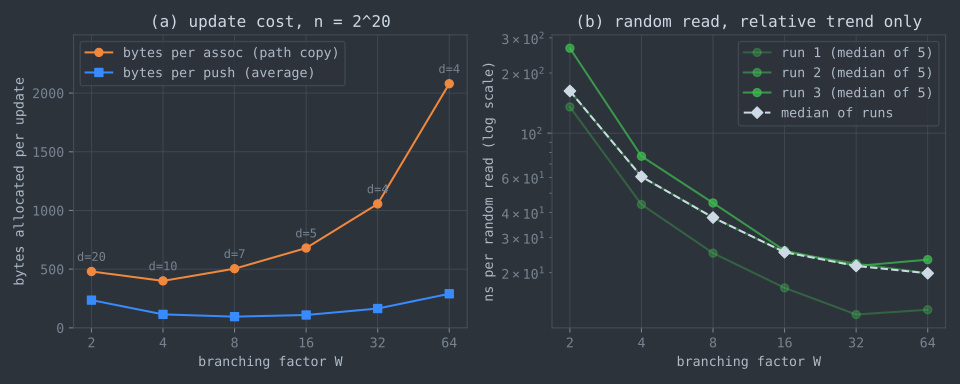
三次运行各自的中位数落在这些区间:\(W = 2\) 时 135 到 266 ns,\(W = 4\) 时 44 到 77 ns,\(W = 32\) 时 12 到 22 ns,\(W = 64\) 时 13 到 23
ns;同一数据放在连续数组里只要 1.7 到 2.7
ns。读延迟由层数决定,\(W\)
从 2 增到 32,层数从 20 降到 4,读快了约一个数量级;从 32 到
64,\(n = 2^{20}\)
时层数都是
4,读几乎不变,更新代价却翻倍。这组数据只在本机、本规模下成立,但它说明了为什么
32
是一个合理的折中:它接近”读已经不再明显变快、写还没有贵到不可接受”的拐点,而且
32 个引用的节点在 JVM 上正好是一个 int
位图能覆盖的宽度,这一点对下一节的 HAMT 更重要。
六、HAMT、CHAMP 与 RRB:哈希映射和可拼接向量
Bagwell 的 HAMT 本身不是持久化结构
Bagwell 2001 年的技术报告 “Ideal Hash Trees” 提出了
HAMT(Hash Array Mapped
Trie):把键的哈希值每 5 位一段,逐层作为 32 路 trie
的下标。每个节点用一个 32
位位图(bitmap)标记哪些分支存在,后面只存放存在的分支,第
\(k\)
个分支在压缩数组中的位置是位图中低于第 \(k\) 位的 1 的个数,用
CTPOP(population
count)指令一步算出。报告描述的是一个可原地修改的哈希表替代品,顶层还有一个可扩容的根哈希表,全文没有讨论持久化。Clojure
的 PersistentHashMap 去掉了根表,让根也是一个
trie
节点,再用路径复制做更新,这才得到持久化的哈希映射。
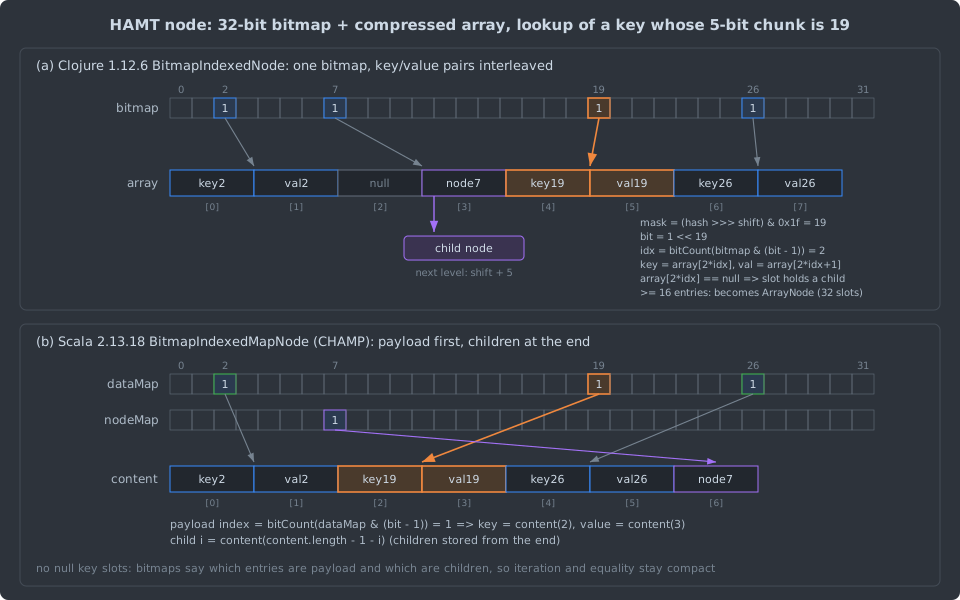
Clojure 的 PersistentHashMap
Clojure 1.12.6 PersistentHashMap.java
中的关键实现:
static int mask(int hash, int shift){
    //return ((hash << shift) >>> 27);// & 0x01f;
    return (hash >>> shift) & 0x01f;
}

private static int bitpos(int hash, int shift){
    return 1 << mask(hash, shift);
}

/* inside final static class BitmapIndexedNode */
    final int index(int bit){
        return Integer.bitCount(bitmap & (bit - 1));
}- 哈希从低位开始消耗,每层 5
位,
shift从 0 开始; BitmapIndexedNode的数组里键和值交错存放:array[2*idx]是键,array[2*idx+1]是值;键槽为null时,值槽放的是子节点;- 节点里已有 16 个条目、还要再插入时,
assoc把它换成ArrayNode:一个直接按 5 位分段下标寻址的 32 格子节点数组,不再需要位图;ArrayNode在孩子数不超过 8 时再失去一个孩子,pack()就把它压回BitmapIndexedNode; - 32 位哈希全部相同的键放进
HashCollisionNode,线性查找。
路径复制发生在 cloneAndSet() 与
new BitmapIndexedNode(null, bitmap, ...)
这几处:沿哈希路径的每个节点复制一次,每次复制的是压缩后的数组,平均比
32 格小。
CHAMP:两个位图与规范形式
Steindorfer 和 Vinju(OOPSLA 2015)的 CHAMP(Compressed Hash-Array Mapped Prefix-tree)针对的是 HAMT 在 JVM 上的两个弱点:迭代和相等比较。Clojure 式的节点里,键值和子节点交错存放,迭代时要逐格判断”这是值还是子节点”;删除后节点也可能留在”只有一个子节点”的非规范状态,两个内容相同的映射可能结构不同,相等比较就不能逐节点短路。CHAMP 的做法是:
- 用
dataMap和nodeMap两个位图分别标记”这一位是键值”和”这一位是子节点”,数组里不再需要null占位; - 键值集中在数组前部,子节点集中在后部,迭代时先顺序扫一段键值,再递归子节点;
- 删除后立即把树压缩成规范形式(canonical form),相同内容的映射有相同的结构。
论文报告(未在本站复现):与 Scala 相比,映射内存占用减少
64%,集合的中位数减少 52%;与 Clojure 相比,映射中位数减少
15%、集合减少 31%;迭代快 1.3 到 6.7 倍,相等比较快 3 到
25.4 倍;查找、插入、删除的性能与 HAMT 持平。Scala 2.13 的
immutable.HashMap 采用了 CHAMP:2.13.18 的
HashMap.scala 文档注释写明 “Compressed
Hash-Array Mapped Prefix-tree” 并引用了这篇论文,节点类
BitmapIndexedMapNode 的字段是
dataMap、nodeMap、content、originalHashes
等,子节点用
content(content.length - 1 - index)
从数组末尾取。Clojure 1.12.6 仍是交错布局。
Scala 的 Vector 与 RRB 树
Scala 的 immutable.Vector 也是宽度 32 的
trie,但 2.13.2 起是一份全新实现(Stefan Zeiger,PR
#8534,2020 年 3 月合入)。2.13.18 Vector.scala
的文档注释说它是 “radix-balanced finger trees of width
32”:为每个高度(0 到
6)各定义一个子类,两端各有一组固定的”手指”(prefix1、suffix1
等切片),前插只动前缀、追加只动后缀;注释给出的复杂度是随机访问与更新
\(O(\log
n)\),前插、追加、tail、init
均摊 \(O(1)\)、最坏 \(O(\log n)\)。
这两种向量里只有靠近两端的节点可以不满,其余节点都是满的,所以下标可以纯靠移位计算。代价是拼接和切片:两个向量拼接时,一方的元素要按另一方的对齐方式重新排布,代价与该向量的长度成正比。RRB 树(Relaxed Radix Balanced tree,Bagwell & Rompf,EPFL 技术报告 2011)放松了这一条:允许节点不满,不满的节点额外带一个累计大小表,查找时在这个节点里先按大小表定位,再继续移位;换来的是 \(O(\log n)\) 的拼接与切片。Stucki、Rompf、Ureche、Bagwell(ICFP 2015)给出了 Scala 上的完整实现与评测;Puente(ICFP 2017)的 C++ 库 immer 实现了 RRB 向量,论文摘要把它概括为”有效常数时间的查找与更新、对数时间的拼接与切片”。
Scala 标准库没有采用 RRB。Zeiger 在 PR #8534 的说明里写得很直接:新 Vector 和旧 Vector 一样”does not use a relaxed radix-balanced tree”,他的目标是做一个”不在任何操作上做性能妥协”的旧 Vector 替代品。这一取舍在第九节再讨论。
七、Git 的对象模型:同构与差异
Git
仓库里有四类对象:blob(文件内容,不含文件名)、tree(目录:文件名、模式、指向
blob 或子 tree 的对象 ID)、commit(指向一个根
tree、零到多个父 commit,以及作者信息)和附注 tag。对象 ID
是对象内容的哈希,默认
SHA-1;git init --object-format=sha256 可以建
SHA-256 仓库,git-init
文档注明两种仓库之间目前不能互操作(Git 2.54.0)。
reproduce/git_path_copy.sh 建一个有
README.md、Makefile、src/main.c、src/util.c
的仓库,提交 A;只改 src/main.c,提交
B。作者和时间固定,所以对象 ID 可复现。以下是实际输出:
objects after A: 7
objects after B: 11
$ git cat-file -p HEAD
tree 235c86d6daeb5e595663b781fe4ab476a9c379ad
parent 16510ce2fabbc24ceaf4c0ef159830c7de36b630
author demo <demo@example.com> 1767225600 +0000
committer demo <demo@example.com> 1767225600 +0000

B
$ git ls-tree -r -t HEAD~1
100644 blob 1263948fb882b8c4fd639b01e17969c825e79619    Makefile
100644 blob fc72a5c1094e203eefcd1c710f060957ebbbaac4    README.md
040000 tree 6ad4892865f47712e87eaf04559b4af8d8bccec2    src
100644 blob f7e582f82533be28c5813e8ea91918eb7fa61cdc    src/main.c
100644 blob 3baf3842041c30efe6be70e87bfa7399b6ea436f    src/util.c
$ git ls-tree -r -t HEAD
100644 blob 1263948fb882b8c4fd639b01e17969c825e79619    Makefile
100644 blob fc72a5c1094e203eefcd1c710f060957ebbbaac4    README.md
040000 tree c2d7ba62b08ae9d63a6f53d4b59d40f90ac5d4e4    src
100644 blob 7424aad076a63f3b6196bd24229e2eeca2fb70ae    src/main.c
100644 blob 3baf3842041c30efe6be70e87bfa7399b6ea436f    src/util.c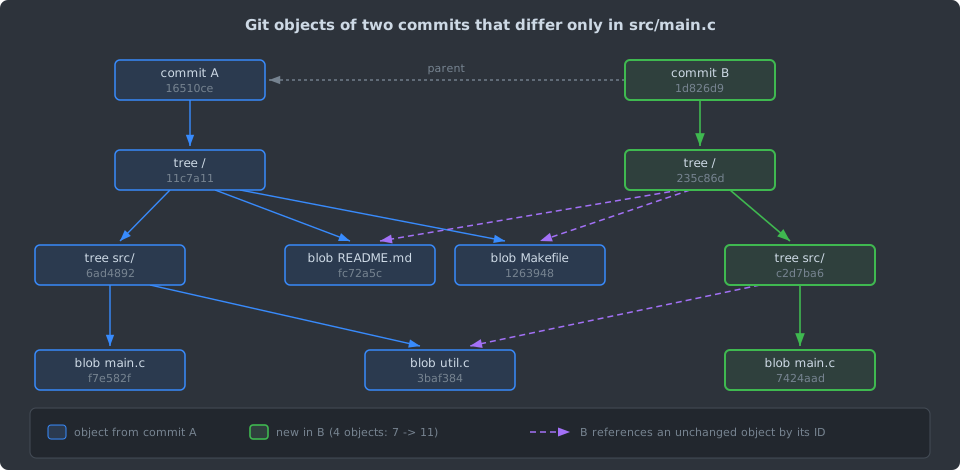
同构的部分:把目录树看成一棵以路径分量为边的树,提交 B 新增的恰好是”被改文件 + 它到根的每一层目录 + 一个 commit”,即 \(1 + 2 + 1 = 4\) 个对象,从 7 个变成 11 个。这就是路径复制:复制路径,共享其余子树,旧版本一个字节都没动。
不同的部分,至少有四处:
- 按内容共享,而不只是按”没改过”共享。 路径复制只共享这次没碰到的子树;两次独立构造出的相同子树在内存里是两份。Git 的对象 ID 就是内容哈希,任何位置、任何提交里内容相同的文件或目录都是同一个对象,相当于对整个版本集合做了哈希合并(hash-consing)。这也让每个 tree 和 commit 的 ID 承诺了其下的全部内容,是一种 Merkle DAG,见站内 Merkle 树与认证数据结构。
- 版本图是 DAG。 合并提交有多个父提交,版本图的形状与汇合持久化一样;但 Git 的”合并”是先用三方合并在内容层面算出结果,再把结果作为一个新快照存下来,数据结构本身没有提供带复杂度保证的合并操作。Demaine、Langerman、Price(Algorithmica 2010)的 “Confluently Persistent Tries for Efficient Version Control” 研究的正是如何让这种合并在数据结构层面也高效。
- 逻辑上是快照,物理上可能是增量。
对象模型里每个 blob 都是完整内容;打包(packfile)时 Git
会把相似对象存成
OFS_DELTA/REF_DELTA增量。这是存储层的压缩,与持久化的逻辑模型无关。 - 回收靠可达性。
不再被任何引用(分支、tag、reflog)可达的对象由
git gc清理,相当于对版本集合做追踪式垃圾回收;内存中的持久化结构在无 GC 的语言里只能靠引用计数(第八节)。
八、工程问题:回收、批量构建与并发
没有 GC 时怎么回收
结构共享意味着一个节点可能属于任意多个版本,“释放某个版本”不能递归
free 整棵树。reproduce/pavl.c
用引用计数:每个版本持有根的一个引用,复制节点时对共享的子树
retain(),释放版本时 release()
沿计数归零的节点向下走。这样做有两个工程细节:
- 释放一个大版本的最后一个引用,会在当前调用里释放整棵树,时间与规模成正比。
pavl.c的release()对右孩子用循环、只对左孩子递归,以免退化成长链时栈溢出。 - 计数本身是共享可变状态。多线程共享版本时要用原子计数(Rust
的
Arc、C++ 的std::shared_ptr),每次retain/release都是一次原子读改写。
用 arena 分配、所有版本用完后整体释放,只适用于版本同生共死的场景:只要某个旧版本比新版本活得久,arena 就无法单独回收新版本。
引用计数还带来一个优化机会:计数为 1
时,说明没有别的版本能看到这个节点,可以原地修改而不复制。Rust
标准库的 Rc::make_mut 就是这样:只有存在其他
Rc 指向同一分配时才克隆内部值(文档称为
clone-on-write)。Puente(ICFP 2017)的 immer 把这一点做成了
C++
的”transient”:用移动语义和引用计数判断独占,独占时原地更新。
批量构建要用 transient 或 builder
第五节的表里,\(W = 32\)
时逐个追加平均每个元素分配 164.5 字节,而元素本身只有 8
字节,这些中间版本随即成为垃圾。批量构建时应当用可变的构建器:Clojure
的
(persistent! (reduce conj! (transient []) xs)),PersistentVector.create
内部也是这么做的;Scala 的
Vector.newBuilder。它们在构建期间原地写,结束时一次性”冻结”成持久化版本。
并发:快照读免锁,写靠 CAS 重试
Clojure 的 atom
持有一个指向不可变值的引用。swap!
的实现(1.12.6 Atom.java,未删减):
public Object swap(IFn f) {
    for(; ;)
        {
        Object v = deref();
        Object newv = f.invoke(v);
        validate(newv);
        if(state.compareAndSet(v, newv))
            {
            notifyWatches(v, newv);
            return newv;
            }
        }
}
读者 deref
拿到的是某个完整版本,永远不会看到”改了一半”的状态,也不需要锁。写者用持久化更新算出新版本,再用
CAS 发布;CAS 失败就用最新值重算。所以传给
swap!
的函数可能执行多次,必须没有副作用;写竞争激烈时,重算的持久化更新本身就是浪费的分配。
常见问题
| 问题 | 表现 | 原因 | 做法 |
|---|---|---|---|
| 旧版本被意外保留 | 内存不降 | 撤销栈、缓存、闭包里还有旧根的引用,整版本可达 | 限制历史长度;只保留需要的版本根 |
| 用持久化接口批量构建 | 分配量是数据量的十几倍(第五节 164.5 字节/元素) | 每次追加都复制 tail 或路径 | transient、builder |
| 均摊结构被当作持久化使用 | 某些调用突然很慢 | 同一旧版本上反复触发昂贵操作(第四节批量队列) | 选惰性或实时版本;或保证版本线性使用 |
| 随机读与遍历比数组慢 | 本机随机读约慢一个数量级(第五节) | 逐层指针跳转,节点分散 | 热路径转成数组快照;遍历用按块迭代器 |
swap! 函数带副作用 |
副作用执行多次 | CAS 失败重试 | 把副作用移到 swap! 之外 |
| 哈希函数差 | 映射操作退化 | Clojure 的 32 位哈希完全相同的键进入
HashCollisionNode 线性查找 |
修正 hashCode;键类型保证哈希质量 |
九、争论与开放问题
争论一:均摊 \(O(1)\) 空间的通用变换为什么没有进入生产库
DSST 证明节点复制比路径复制省一个对数因子的空间,Brodal
进一步做到最坏 \(O(1)\)。但
Clojure、Scala 的集合和 Haskell containers(0.8
的 Data.Map 基于 Adams
的大小平衡树,Data.Sequence 基于 Hinze–Paterson
的 2-3 finger
tree)都用路径复制或纯函数式构造。下面是本文的工程判断,依据是
DSST 第 2.3.2 节对更新过程的描述:
- 节点复制要写入已有节点:往旧节点的额外槽位里记新指针,维护逆指针。旧版本在物理上不再是只读的,并发读者需要同步,纯函数式语言里也无法表达。DSST 第 6 节给出过”除访问指针外只写一次”(write-once)的变体,写入次数有界,但写入依然发生在共享节点上。
- 它要求入度有常数上界并维护逆指针,而路径复制对树形结构什么都不要求。
- 宽分支让”省下的对数因子”变小:\(W = 32\)、\(n = 2^{20}\) 时路径只有 4 层,节点复制要付出的是每个节点 \(p + e + 1\) 个额外槽位和版本戳。
纯函数式到底要付多少代价,理论上有两方面的结果。DSST 第 6
节指出,节点复制可以改成除访问指针外只写一次,由此任何入度有常数上界、用
rplaca/rplacd 构造的结构,都能只用
cons、car、cdr
在线性时间内模拟。另一方面,Pippenger(POPL
1996)构造了一个在线问题,允许修改的 Lisp 能在 \(O(n)\)
时间内解决,而任何严格求值的纯 Lisp 程序都需要 \(\Omega(n \log n)\)。DSST
的模拟只覆盖入度有常数上界的结构,与这个下界并不冲突。Bird、Jones、de
Moor(JFP 1997)随后指出,在惰性求值下,同一问题可以在 \(O(n)\)
内解决,下界并不适用于惰性语言。这与第四节 Okasaki
的结论一致,惰性求值和记忆化本身就是一种受控的”修改”。
争论二:要不要放松平衡
RRB 一派(Bagwell & Rompf 2011;Stucki 等
2015;Puente
2017)认为,可拼接、可切片是通用不可变序列的基本能力,值得为不满的节点付出大小表的查找开销;immer
与 Clojure 的独立库 core.rrb-vector 都实现了
RRB 向量。Scala 2.13 的 Vector
重写选择了另一条路:保持严格的 radix-balanced
结构,用两端的手指把前插、追加做到均摊 \(O(1)\),目标是不在任何已有操作上变慢。两种选择的评测都来自各自作者,面向的负载也不同,本站没有做交叉对比。
争论三:哈希 trie 的节点布局
CHAMP
论文报告的迭代与相等比较提速来自两点:键值与子节点分区存放,以及删除后维持规范形式。Scala
2.13 采纳了它,Clojure 1.12.6 仍是交错布局加
ArrayNode。这类差异只影响常数,但对”把大映射当作值来比较、来遍历”的程序(论文的例子是不动点迭代的程序分析)影响很大;论文中这类程序的端到端加速是
9.9 到 28.1 倍。
开放问题
- 完全持久化的最坏 \(O(1)\)。 DSST 开放问题 (i) 要求把每个更新步的 \(O(1)\) 从均摊改成最坏。Brodal 解决了部分持久化的情形;MIT 6.851(Demaine,2021 春)第 1 讲的课程页面把完全持久化的版本列为仍然开放。它的实际意义在于延迟敏感的系统:均摊界允许偶发的长级联复制。
- 汇合持久化的通用变换。 Fiat 和 Kaplan(2003)给出每次操作 \(O(e(v))\) 的通用变换,其中 \(e(v) = 1 + \log(\text{从根到 } v \text{ 的路径数})\),衡量版本 DAG 偏离树的程度;Collette、Iacono、Langerman(SODA 2012)对只合并互不共享节点的版本(disjoint)这一情形做到 \(O(\log n)\)。6.851 的课程页面写明,一般情形下每次操作 \(O(\log n)\) 或更低的代价仍是开放问题。版本控制系统里的合并就是这种操作。
- 无界入度。 DSST 开放问题 (iv):入度无界时节点复制与节点分裂完全失效,只剩胖节点,访问要多付 \(O(\log m)\)。一般图结构的持久化至今没有常数因子开销的通用方法。
十、参考资料
源码与文档
- Clojure
1.12.6:
src/jvm/clojure/lang/PersistentVector.java(tailoff、arrayFor、assocN、doAssoc、cons、pushTail、TransientVector)、PersistentHashMap.java(mask、bitpos、BitmapIndexedNode、ArrayNode、HashCollisionNode)、Atom.java(swap)。 - Clojure 官方文档:Data Structures,clojure.org/reference/data_structures。
- Scala
2.13.18:
src/library/scala/collection/immutable/Vector.scala、HashMap.scala(BitmapIndexedMapNode)、ChampCommon.scala;scala/scala PR #8534 “Rewrite Vector (now radix-balanced finger tree vectors), for performance”,Scala 2.13.2 发布说明。 - Haskell
containers0.8:Data.Map.Strict、Data.Sequence模块文档。 - Git
2.54.0:
git-init(--object-format)文档;pack 格式文档中的OFS_DELTA/REF_DELTA。 - Rust
标准库文档:
std::rc::Rc::make_mut。
核心论文
- J. R. Driscoll, N. Sarnak, D. D. Sleator, R. E. Tarjan, “Making Data Structures Persistent”, Journal of Computer and System Sciences 38(1): 86–124, 1989(初版 STOC 1986)。
- N. Sarnak, R. E. Tarjan, “Planar Point Location Using Persistent Search Trees”, CACM 29(7): 669–679, 1986.
- C. Okasaki, Purely Functional Data Structures, Cambridge University Press, 1998.
- P. Bagwell, “Ideal Hash Trees”, EPFL Technical Report, 2001.
- M. J. Steindorfer, J. J. Vinju, “Optimizing Hash-Array Mapped Tries for Fast and Lean Immutable JVM Collections”, OOPSLA 2015.
- N. Stucki, T. Rompf, V. Ureche, P. Bagwell, “RRB Vector: A Practical General Purpose Immutable Sequence”, ICFP 2015.
- A. Fiat, H. Kaplan, “Making Data Structures Confluently Persistent”, Journal of Algorithms 48(1): 16–58, 2003.
其他论文
- E. W. Myers, “Efficient Applicative Data Types”, POPL 1984.
- P. Dietz, D. Sleator, “Two Algorithms for Maintaining Order in a List”, STOC 1987.
- G. S. Brodal, “Partially Persistent Data Structures of Bounded Degree with Constant Update Time”, BRICS Report RS-94-35, 1994;期刊版 Nordic Journal of Computing 3(3), 1996.
- J. R. Driscoll, D. D. Sleator, R. E. Tarjan, “Fully Persistent Lists with Catenation”, JACM 41(5): 943–959, 1994.
- R. Hood, R. Melville, “Real-Time Queue Operations in Pure LISP”, Information Processing Letters 13(2): 50–54, 1981.
- C. Okasaki, “Simple and Efficient Purely Functional Queues and Deques”, Journal of Functional Programming 5(4): 583–592, 1995.
- C. Okasaki, “Red-Black Trees in a Functional Setting”, Journal of Functional Programming 9(4): 471–477, 1999.
- S. Kahrs, “Red-Black Trees with Types”, Journal of Functional Programming 11(4): 425–432, 2001.
- K. Germane, M. Might, “Deletion: The Curse of the Red-Black Tree”, Journal of Functional Programming 24(4): 423–433, 2014.
- H. Kaplan, R. E. Tarjan, “Purely Functional, Real-Time Deques with Catenation”, JACM 46(5): 577–603, 1999.
- S. Adams, “Efficient Sets—A Balancing Act”, Journal of Functional Programming 3(4): 553–561, 1993.
- R. Hinze, R. Paterson, “Finger Trees: A Simple General-Purpose Data Structure”, Journal of Functional Programming 16(2): 197–217, 2006.
- N. Pippenger, “Pure versus Impure Lisp”, POPL 1996.
- R. Bird, G. Jones, O. de Moor, “More Haste, Less Speed: Lazy versus Eager Evaluation”, Journal of Functional Programming 7(5): 541–547, 1997.
- E. D. Demaine, S. Langerman, E. Price, “Confluently Persistent Tries for Efficient Version Control”, Algorithmica 57(3): 462–483, 2010.
- S. Collette, J. Iacono, S. Langerman, “Confluent Persistence Revisited”, SODA 2012.
- P. Bagwell, T. Rompf, “RRB-Trees: Efficient Immutable Vectors”, EPFL Technical Report, 2011.
- J. P. Bolívar Puente, “Persistence for the Masses: RRB-Vectors in a Systems Language”, Proceedings of the ACM on Programming Languages 1(ICFP), 2017.
课程资料
- E. D. Demaine, MIT 6.851 Advanced Data Structures(Spring 2021),L01 “Temporal” 课程页面,courses.csail.mit.edu/6.851/spring21/lectures/。
实验
reproduce/pavl.c:持久化 AVL(路径复制 + 引用计数),第二节数据。reproduce/pvec.c:可调分支因子的位切分向量 trie,第五节数据;reproduce/plot_branching.py生成branching-tradeoff.svg。reproduce/queue_amort.py:批量队列与实时队列,第四节数据。reproduce/git_path_copy.sh:第七节的 Git 输出。reproduce/gen_hamt_svg.py:生成hamt-node.svg。reproduce/results/:上述程序的原始输出。
复现命令:
cd reproduce
gcc -O2 -Wall -Wextra -o pavl pavl.c && ./pavl demo && ./pavl test && ./pavl measure
gcc -O2 -Wall -Wextra -o pvec pvec.c && ./pvec test && ./pvec measure
for r in 1 2 3; do taskset -c 15 ./pvec time 1048576 5; done
python3 queue_amort.py
bash git_path_copy.sh
python3 plot_branching.py      # 需要 matplotlib,读取 results/ 重画 ../branching-tradeoff.svg
系列导航: - 上一篇:线段树与树状数组 - 下一篇:Van Emde Boas 树
相关阅读: - 记录历史:持久化数据结构(节点复制的逐步推演) - Merkle 树与认证数据结构 - 红黑树 vs AVL - MVCC 实现变体
读完这篇,下一步读什么
优先读同系列或同问题的下一篇,把单篇消费变成主题集群。
Merkle 树与认证数据结构:从 Git 到区块链
在不可信的网络环境中,我们如何仅凭一个哈希值就能验证 TB 级数据的完整性?Merkle 树给出了一个优雅到令人惊叹的答案。
TimSort:自然 run、galloping 与从栈不变量到 Powersort 的合并策略
对照 CPython 与 OpenJDK 源码拆解 TimSort 的 run 检测、minrun、galloping 与合并,梳理 2015 年栈不变量 bug 和改用 Powersort 的原因;比较次数来自与 CPython 逐次一致的 C 移植。
pdqsort:坏分区计数、重复键分区与块分区如何改造 introsort
对照 orlp/pdqsort 源码与 Peters 论文,拆解 pdqsort 在 introsort 上的四处改动;用与参考实现比较次数逐次一致的 C 移植和 McIlroy 对抗输入实测,并梳理 Boost、Rust、Go、libc++ 各自采用了哪些部分。
基数排序:绕开比较下界的代价,从 LSD、American flag sort 到 ska_sort
比较下界只约束比较模型,基数排序把代价转移到键长和内存访问上。本文推导代价模型,用缓存模拟与绑核实测解释位宽为何停在 8 到 11 位,并对照 ska_sort、ClickHouse、DuckDB 与 IPS²Ra 说明它何时赢、何时输。