同一条 SQL 可以写得很短,执行计划却可能从一次索引嵌套循环到多路哈希连接差几个数量级。优化器要解决的问题不是“会不会用 hash join”,而是在三件事之间同时取舍:哪些等价变换应该纳入搜索,哪些物理性质值得为上层保留,以及统计信息的误差会不会把搜索导向错误的计划。
本文按一条线索展开:System R 用左深动态规划和 interesting
orders 建立了代价优化器的基本范式;Volcano/Cascades
把等价表达式、规则和物理性质放进 memo;后来的 DPccp/DPhyp
重新审视 join-order
枚举;生产系统再用阈值、启发式和超时约束规划时间。所有枚举数字与基数误差实验来自同目录
reproduce/query_optimizer_experiment.py,源码事实钉住
PostgreSQL REL_16_9 与 Apache Calcite 1.37.0。
一、优化器到底在优化什么
关系查询优化器输入的是逻辑代数树,输出的是物理执行计划。对一个只含内连接的子问题,可以把参与连接的表记为集合 \(S\),优化器通常要为每个 \(S\) 找到若干候选计划:
- 逻辑等价:\(A \bowtie B\) 与 \(B \bowtie A\) 等价,\((A \bowtie B) \bowtie C\) 与 \(A \bowtie (B \bowtie C)\) 在内连接且谓词可重排时等价;
- 物理实现:同一个逻辑 join 可以实现为 nested loop、hash join 或 merge join;这些算子的代价和输出顺序不同;
- 物理性质(physical properties):输出是否按某个键有序、是否已分区、使用哪种执行 convention,会影响上层是否还要排序或 repartition;
- 统计估计:基表行数、列直方图、最常见值、distinct 值和谓词选择率决定代价模型的输入。
对 \(n\) 张表,左深树的叶子排列已有 \(n!\) 种;完全二叉 bushy 树的叶子标号数为 \(n! C_{n-1}\),其中 \(C_{n-1}\) 是 Catalan 数。\(n=10\) 时,左深排列是 \(3,628,800\),bushy 形状乘标号是 \(17,643,225,600\)。这还没有乘上访问路径、join 算子和有序性的组合。优化器必须把“枚举足够多”与“规划时间可接受”同时作为目标。
本文不重复上一篇 Join 算法:嵌套循环、排序归并与 Hybrid Hash 的代价和实现 已经讲过的 join 算子内部实现;这里把 join 当作候选物理算子,重点看它们如何被组织进搜索空间。
二、System R:左深动态规划与 interesting orders
Selinger、Astrahan、Chamberlin、Lorie 和 Price 在 SIGMOD 1979 的 “Access Path Selection in a Relational Database Management System” 中给出了后来代价优化器的基本形状。System R 的输入是关系代数表达式和统计信息,输出是预计代价最小的访问路径与连接顺序。它有三个今天仍能在优化器里看到的设计。
左深动态规划
System R 只枚举左深树(left-deep
tree):每一步把已经得到的中间结果与一个基表相连。设
best[S, p] 是连接集合 \(S\)、并满足物理性质 \(p\)
的最佳计划,简化后的递推是:
for each base relation R:
    keep cheapest access paths for {R}
for size = 2..n:
    for each subset S with |S| = size:
        for each R in S:
            L = S - {R}
            if L can join R:
                combine every retained plan of L with every access path of R
                keep cheapest plan per required physical property
这个递推利用了最优子结构:若一个左深计划最后一步是 \(L \bowtie R\),那么 \(L\) 的子计划也应该是某个性质下的最优候选。它牺牲了 bushy 计划,但让搜索从超指数形状压到按子集组织的动态规划。PostgreSQL 的常规 join 搜索仍然按 join relation 的大小分层,这一点与 System R 的思路相同,尽管它会在有连接谓词时生成有限的 bushy 组合(第七节)。
Interesting orders
System R
的一个关键洞察是:局部最便宜不等于全局最便宜。一个索引扫描也许比顺序扫描贵,但它输出的顺序可能让上层
merge join、ORDER BY 或 GROUP BY
省掉排序。System R 把这种对后续算子有价值的顺序称为
interesting order。
因此,优化器不能只为每个 \(S\) 保留一个最低代价计划,而要按物理性质保留多个候选:一个可能是无序但便宜的 hash join,另一个可能是稍贵但按连接键有序的 merge join。这个想法后来在 Volcano/Cascades 里被推广为 trait 或 physical property。
代价公式与边界
System R 论文里的代价函数把页读取(page fetch)与 RSI 调用数(可近似理解为元组级 CPU 工作)合在一起,形式是页读取数加权 CPU 调用数。这个模型很粗,但它确立了一个原则:优化器比较的是估算代价,而估算代价由统计信息、算子模型和物理性质共同决定。
这也给 System R 留下边界:它主要处理单块查询的访问路径与左深 join 顺序;对于大量等价变换、复杂物理属性和可扩展规则集,手写动态规划会迅速变得难维护。
三、连接顺序枚举:形状比表数更重要
连接顺序不是只由表数决定,还由查询图决定。把每张表看成顶点,每个 join 谓词看成边;不允许笛卡尔积时,候选子计划必须对应连通子图。链、星和团三种图在同样表数下给优化器的压力完全不同。
reproduce/query_optimizer_experiment.py
实现了两个小枚举器:
- DPsize-left-deep:按集合大小枚举左深扩展,只把一个已连通子集与一个相邻基表相连;
- DPccp-style csg-cmp:按连通子图(connected subgraph, CSG)与互补连通子图(CMP)成对枚举可连接的 bushy 拆分。它不是 Moerkotte–Neumann 论文的逐行复刻,但计数口径与 DPccp 的核心对象一致:只枚举有连接谓词的 CSG-CMP 对。
运行命令:
cd post/algorithms/60-query-optimizer/reproduce
taskset -c 15 python3 query_optimizer_experiment.py
本机复核环境是 Python 3.14.5、matplotlib 3.11.2、Linux
6.6.87.2,CPU 可用编号为
0–23;实验指标是候选数和代价比,不依赖墙钟时间。脚本输出
results/enumeration_counts.csv、results/cardinality_error.csv、results/summary.txt,并重画本文三张
SVG。
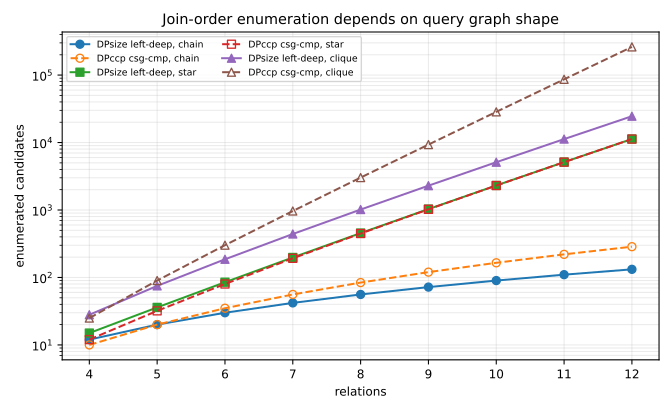
\(n=12\) 时,脚本得到的候选数如下:
| 查询图 | 连通子集数 | DPsize 左深候选 | CSG-CMP 候选 |
|---|---|---|---|
| chain | 78 | 132 | 286 |
| star | 2,059 | 11,275 | 11,264 |
| clique | 4,095 | 24,564 | 261,625 |
三点值得注意。
第一,链式查询虽然有 12 张表,但连通子集只有所有区间,共 \(78\) 个;优化器只要沿相邻边扩展,搜索很小。第二,星形查询的连通子集已经接近 \(2^{11}\):任何包含中心点的叶子集合都是连通的。第三,团图中 bushy CSG-CMP 候选远多于左深候选,因为任意两个不相交子集都能连接。只看“表数超过多少”不能判断优化难度,查询图的稠密度同样关键。
Moerkotte 和 Neumann 的贡献就在这里。VLDB 2006 的 DPccp 关注如何枚举 connected subgraph/complement pair 而不重复、且避免无连接谓词的笛卡尔积;SIGMOD 2008 的 “Dynamic Programming Strikes Back” 引入 DPhyp,把动态规划扩展到更复杂的 hypergraph 表达。它们反驳了“DP 只能做小查询”的简单说法:如果枚举对象选得对,DP 在不少实际查询上仍有竞争力。
四、Volcano 与 Cascades:memo、规则和性质
Graefe 与 McKenna 在 ICDE 1993 的 Volcano Optimizer Generator 中把优化器写成可扩展的规则系统:逻辑变换、物理实现和搜索策略解耦。Graefe 1995 年的 Cascades 进一步把 memo、top-down 搜索和物理性质整合成一个框架。今天很多系统并不逐字实现 Cascades,但 memo 化搜索、规则驱动和 trait 传播已经成了优化器工程的通用语言。
Memo 的结构
Cascades memo 不是一棵树,而是等价表达式的 DAG。一个 group 表示同一逻辑结果的等价类;一个 group expression 是某个具体表达式,它的孩子指向 group,而不是指向某棵固定子树。这样,交换律、结合律生成的新表达式可以共享同一个子问题。
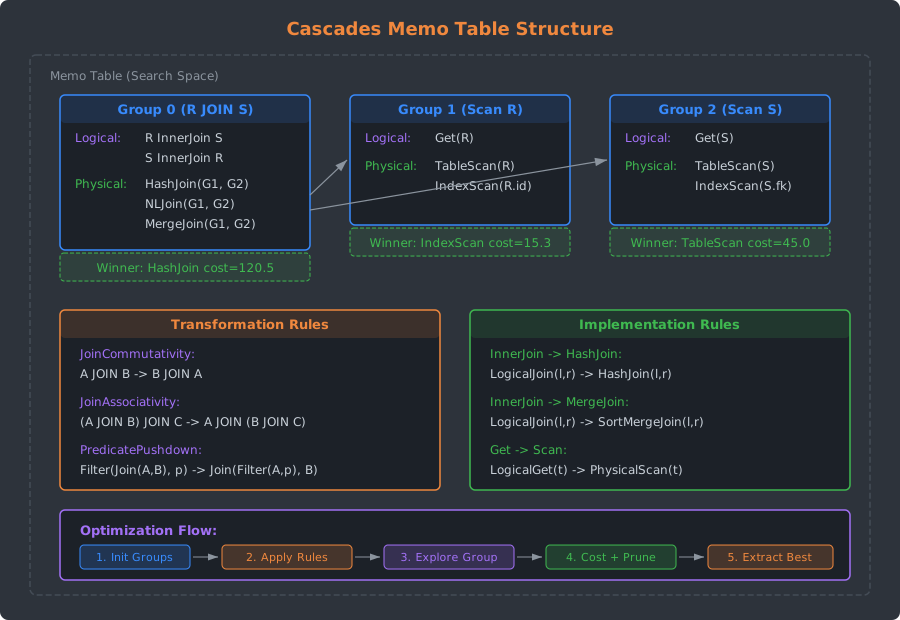
图里 Group 0
表示三表连接结果;它可以包含逻辑 join
的不同结合顺序,也可以包含 hash join、merge join
等物理表达式。Group 1、Group 2
等子 group 被多条表达式共享。重要的是:winner
不是全局唯一的。同一个 group 可能在“无序输出”下 hash join
最便宜,在“按连接键有序”下 merge join 加少量排序更便宜。
规则与 enforcer
Cascades 风格的规则通常分三类:
| 规则类型 | 输入与输出 | 例子 |
|---|---|---|
| transformation | 逻辑表达式到逻辑表达式 | join commutativity、join associativity、predicate pushdown |
| implementation | 逻辑表达式到物理表达式 | logical join \(\rightarrow\) hash join / merge join / nested loop |
| enforcer | 改变物理性质 | sort enforcer 产生有序输出,exchange enforcer 产生分区输出 |
Top-down 搜索从根 group 和 required properties 出发,给每个子 group 传递所需性质与剩余代价上界。若当前表达式的局部代价已经超过上界,就可以剪枝。这与 System R 的 bottom-up DP 不矛盾:两者都依赖 memo,只是搜索方向与规则组织不同。
Calcite 的 VolcanoPlanner
Apache Calcite 1.37.0 的
org.apache.calcite.plan.volcano.VolcanoPlanner
是一个可核对的生产级例子。findBestExp() 会先
ensureRootConverters(),再
ruleDriver.drive() 触发规则,最后调用
root.buildCheapestPlan(this)
生成最便宜计划。registerImpl() 会调用
rel.onRegister(this) 递归注册子表达式,用
digest 去重,并把等价表达式放入 RelSet /
RelSubset。
Calcite 的名字是 VolcanoPlanner,但它也有 Cascades 语境里的关键部件:memo 化等价类、规则驱动、trait set 和 converter。把它称为“使用 Volcano/Cascades 思想的 planner”比把它说成某篇论文的逐字实现更准确。
五、基数估计:优化器争论的主战场
搜索算法再精巧,也要吃估算基数。设真实基数为 \(c\),估计基数为 \(\hat c\),数据库论文常用 q-error 衡量相对误差:
\[ q(\hat c, c) = \max\left(\frac{\hat c}{c}, \frac{c}{\hat c}\right). \]
\(q=1\) 表示完全准确,\(q=10\) 表示高估或低估 10 倍。Ioannidis 和 Christodoulakis 在 SIGMOD 1991 的 “On the Propagation of Errors in the Size of Join Results” 中已经指出,join 结果大小误差会沿连接树传播;在独立性假设失效时,多个选择率误差会相乘。
一个可复现实验
脚本里的第二个实验固定一张 6 表查询图和真实选择率。优化器用带 lognormal 噪声的选择率估计做左深 DP,选出计划;然后用真实选择率重新计算该计划的真实代价,并与真实最优左深计划比较。每个误差强度跑 30 个固定种子,指标仍然不依赖时钟。
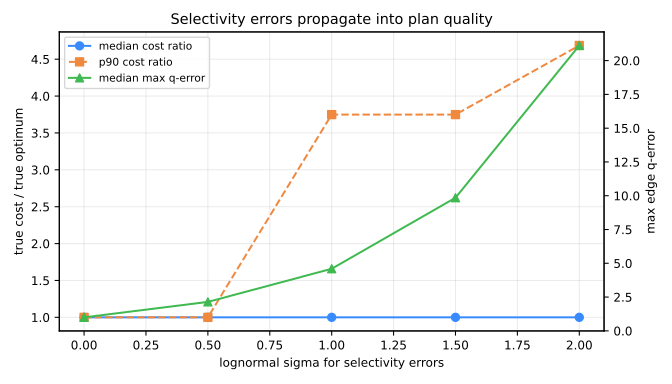
results/summary.txt 的汇总如下:
| lognormal \(\sigma\) | 最大边 q-error 中位数 | 真实代价比中位数 | 真实代价比 p90 | 最坏真实代价比 |
|---|---|---|---|---|
| 0.0 | 1.00 | 1.00 | 1.00 | 1.00 |
| 0.5 | 2.14 | 1.00 | 1.00 | 3.75 |
| 1.0 | 4.60 | 1.00 | 3.75 | 4.69 |
| 1.5 | 9.85 | 1.00 | 3.75 | 4.69 |
| 2.0 | 21.12 | 1.00 | 4.69 | 44.98 |
这个小实验不代表真实数据库负载,但它展示了两个机制。第一,轻微误差不一定改变计划:许多种子下最优顺序仍然稳定,所以中位数代价比为 1。第二,尾部风险增长很快:当某几条边同时被严重低估或高估,优化器会把大中间结果提前物化,最坏代价比达到 \(44.98\)。
Leis、Gubichev、Mirchev、Boncz、Kemper 和 Neumann 在 PVLDB 2015 的 “How Good Are Query Optimizers, Really?” 用 Join Order Benchmark 系统地讨论了同一个问题。他们把优化器拆成四部分评估:基数估计、代价模型、物理算子选择和枚举算法。论文的核心结论是:在他们的实验中,基数估计误差是导致坏计划的主因;如果喂给优化器真实基数,很多系统即使用相对简单的代价模型也能得到接近最优的计划。
这不是说代价模型无关。代价模型决定 hash join、merge join、index nested loop、排序和并行的取舍;但如果一个中间结果被估成 \(10^3\) 行、真实却是 \(10^9\) 行,再精细的 CPU cache 参数也救不了错误的连接顺序。
六、代价模型:粗糙但必须一致
一个代价模型至少要把三类量放到同一单位里:
- I/O:顺序读、随机读、临时文件写入、缓存命中概率;
- CPU:谓词求值、哈希计算、排序比较、函数调用;
- 内存与物理性质:hash table 是否溢出、排序是否多趟、输出是否满足上层顺序。
System R 的页读取加 CPU
调用只是最早的版本。现代系统会有更多参数,但核心仍是“可比较”。PostgreSQL
的 EXPLAIN 显示的是抽象
cost,不是毫秒;MySQL、SQL Server、Oracle
也不会把代价单位暴露成真实时间。抽象单位的好处是稳定,坏处是参数不准时容易和硬件脱节。
Interesting orders 可以看成代价模型与物理性质的交界:一个计划为了保持排序多花了本地代价,但让上层少一次排序。Cascades 的 required properties 则把这种取舍系统化:上层请求“需要按 \(k\) 有序”,子 group 才会比较“直接产生有序输出”和“先无序输出再加 sort enforcer”的总代价。
工程上最危险的不是模型简单,而是模型前后不一致。例如,规划阶段认为 hash join 不会溢出,执行阶段却因为内存估计错误分批落盘;或者统计信息假设列独立,真实数据里两个过滤条件高度相关。这些问题最终都会以“代价模型输入错了”的形式表现出来。
七、PostgreSQL 16:DP、bushy 限制与 GEQO
PostgreSQL REL_16_9 的常规 join 搜索可以在
src/backend/optimizer/path/joinrels.c
里直接看到。join_search_one_level(PlannerInfo *root, int level)
的注释写明:它构造恰好包含 level 个 jointree
items 的 join relations,是
standard_join_search 动态规划的一步。
代码分三段。
- 先把
level - 1个关系的 joinrel 与一个基表相连,也就是左深或右深扩展。若有相关 join clause 或 join order restriction,调用make_rels_by_clause_joins();若没有,就生成必要的 clauseless join。 - 再枚举 bushy 组合:把大小为 \(k\) 的 joinrel 与大小为
level-k的 joinrel 相连,但只在have_relevant_joinclause()或have_join_order_restriction()成立时生成,避免无谓的笛卡尔积爆炸。 - 如果前面完全没有生成可用 joinrel,最后才用 clauseless join 兜底,处理某些 join 子问题被语法边界隔开的特殊情况。
make_rels_by_clause_joins()
的注释还说明,(a join b) join c 与
(b join c) join a 会落到同一个
RelOptInfo,不同路径作为 Path
加进去;join_rel_level 机制保证新 joinrel
只加入列表一次。这正是 memo 思想在 PostgreSQL
自有数据结构里的体现。
表很多时,PostgreSQL 默认不再使用穷举
DP。src/backend/utils/misc/guc_tables.c 中
geqo_threshold 的默认值是 12,说明文字是 “Sets
the threshold of FROM items beyond which GEQO is
used.”。达到阈值后会进入 GEQO(Genetic Query
Optimizer):src/backend/optimizer/geqo/geqo_main.c
里可以看到
gimme_pool_size()、gimme_number_generations()、random_init_pool()、sort_pool()
以及 chromosome 交叉变异相关代码。
这不是“PostgreSQL 只能优化 12
表以内查询”。准确说法是:默认配置下,FROM items 数达到
12(levels_needed >= geqo_threshold)时,优化器为了限制规划时间,会从穷举动态规划切到遗传搜索;用户可以调整
geqo_threshold 或关闭
GEQO,但代价是规划时间可能急剧上升。
八、学习型优化器:开放问题而不是替代品
学习型优化器常被写成“取代 CBO”,但论文里的主张更具体。
Neo(Marcus、Negi、Mao、Zhang、Alizadeh、Kraska、Papaemmanouil、Tatbul,PVLDB 2019)把优化过程表示成候选计划搜索与神经网络价值评估:模型从已执行查询中学习计划质量,逐步引导搜索。Bao(Marcus、Negi、Mao、Tatbul、Alizadeh、Kraska,SIGMOD 2021)更工程化:它不直接生成任意计划,而是在现有优化器外面选择一组 hint,让底层数据库继续负责合法计划生成;模型根据实际执行反馈更新。
二者的共同点是:都承认传统优化器已有大量工程约束,学习组件更现实的位置是补充估计或选择,而不是绕过执行器、事务语义和物理算子限制从零生成计划。
学习型方向仍有几个具体开放问题:
- 安全性:模型探索坏计划会直接伤害线上查询,Bao 用 hint 集合限制动作空间,就是为了降低风险;
- 分布漂移:统计信息、数据分布、索引和硬件变化后,历史反馈不一定可靠;
- 冷启动:新 workload 没有足够执行样本,纯学习方法很难优于 CBO 的先验;
- 可解释性与调试:DBA 需要知道坏计划来自统计信息、规则缺失、代价参数,还是模型误判。
因此,本篇把学习型优化器放在开放问题里,而不是把它写成 System R → Cascades 之后的必然终点。Leis 等人的结论也提醒我们:先把基数估计、相关性建模和生产实现里的边界做好,往往比换一个搜索器更重要。
九、工程判断:读执行计划时先看什么
面对一条慢 SQL,按下面顺序排查比直接调优化器开关更稳。
| 问题 | 观察点 | 常见处理 |
|---|---|---|
| 基数估计是否错得离谱 | EXPLAIN ANALYZE 中 estimated rows 与 actual
rows 的 q-error |
更新统计信息,增加多列统计,改写相关谓词,必要时拆查询 |
| Join 顺序是否由坏估计触发 | 大中间结果是否过早出现 | 先修统计;临时用 hint 或 join order 约束验证假设 |
| 物理算子是否溢出 | hash join batch 数、sort spill、临时文件 I/O | 调整 work memory 或让过滤更早发生 |
| Interesting order 是否被利用 | 计划中是否额外 sort,索引顺序是否能满足
ORDER BY/merge join |
增加合适索引或避免破坏顺序的算子 |
| 规划时间是否过长 | 表数、查询图稠密度、是否触发 GEQO/超时 | 分解查询、物化中间结果,或调整搜索阈值 |
几个经验边界也要分清。
- 左深树不是低级实现。它牺牲部分 bushy 计划,换来流水线和可控搜索;在星型事实表查询里,左深计划常常已经足够好。
- Bushy 枚举不是越多越好。第三节实验显示团图 12 表的 CSG-CMP 候选已达 261,625;若再乘物理算子和 trait,规划时间会成为问题。
- Hint 不是根治。Hint 能验证“如果按这个顺序会更快”,但统计信息仍然错时,下一条相似 SQL 可能继续失败。
- 真实执行反馈很有价值,但不能替代优化器正确性。自适应 re-optimization、Bao 这类 feedback 方法都需要安全边界。
十、复现程序说明
reproduce/query_optimizer_experiment.py
做三件事:
- 枚举 chain、star、clique 三种查询图在 \(n=4..12\) 时的连通子集、左深候选和 CSG-CMP 候选;
- 在固定 6 表查询图上注入选择率估计误差,记录最大 q-error、所选计划真实代价和真实最优代价;
- 生成
plan-enumeration.svg、cardinality-error.svg与cascades-memo.svg。
复现命令如下(需要 Python 3 与 matplotlib;脚本只输出计数与代价,不计时):
cd post/algorithms/60-query-optimizer/reproduce
taskset -c 15 python3 query_optimizer_experiment.py
cat results/summary.txt输出应与第三、五节表格一致:n=12 时
chain/star/clique 的候选数分别为
132/11,275/24,564(左深)和
286/11,264/261,625(CSG-CMP);sigma=2.0
时
median_q=21.12、p90_regret=4.69、worst=44.98。
如果系统 Python 没有 matplotlib,安装依赖或使用带
matplotlib
的虚拟环境即可;脚本本身不依赖本机私有路径。生成图使用固定
svg.hashsalt,没有墙钟时间元数据。
十一、参考资料
源码与文档
- PostgreSQL REL_16_9,
src/backend/optimizer/path/joinrels.c:join_search_one_level()、make_rels_by_clause_joins()、make_rels_by_clauseless_joins()。 - PostgreSQL REL_16_9,
src/backend/utils/misc/guc_tables.c:geqo_threshold默认值 12。 - PostgreSQL REL_16_9,
src/backend/optimizer/geqo/geqo_main.c:GEQO pool、generation 与 chromosome 搜索主流程。 - Apache Calcite 1.37.0,
core/src/main/java/org/apache/calcite/plan/volcano/VolcanoPlanner.java:findBestExp()、registerImpl()。 - Apache Calcite 1.37.0,
RelSet.java与RelSubset.java:Volcano planner 的等价集合与 trait 子集。
核心论文
- P. G. Selinger, M. M. Astrahan, D. D. Chamberlin, R. A. Lorie, T. G. Price, “Access Path Selection in a Relational Database Management System”, SIGMOD 1979, pp. 23–34.
- Goetz Graefe, William J. McKenna, “The Volcano Optimizer Generator: Extensibility and Efficient Search”, ICDE 1993, pp. 209–218.
- Goetz Graefe, “The Cascades Framework for Query Optimization”, IEEE Data Engineering Bulletin 18(3), 1995, pp. 19–29.
- Yannis E. Ioannidis, Stavros Christodoulakis, “On the Propagation of Errors in the Size of Join Results”, SIGMOD 1991, pp. 268–277.
- Viktor Leis, Andrey Gubichev, Atanas Mirchev, Peter Boncz, Alfons Kemper, Thomas Neumann, “How Good Are Query Optimizers, Really?”, Proceedings of the VLDB Endowment 9(3), 2015, pp. 204–215.
Join 枚举论文
- Guido Moerkotte, Thomas Neumann, “Analysis of Two Existing and One New Dynamic Programming Algorithm for the Generation of Optimal Bushy Join Trees without Cross Products”, VLDB 2006, pp. 930–941.
- Guido Moerkotte, Thomas Neumann, “Dynamic Programming Strikes Back”, SIGMOD 2008, pp. 539–552.
学习型优化器
- Ryan Marcus, Parimarjan Negi, Hongzi Mao, Chi Zhang, Mohammad Alizadeh, Tim Kraska, Olga Papaemmanouil, Nesime Tatbul, “Neo: A Learned Query Optimizer”, Proceedings of the VLDB Endowment 12(11), 2019, pp. 1705–1718.
- Ryan Marcus, Parimarjan Negi, Hongzi Mao, Nesime Tatbul, Mohammad Alizadeh, Tim Kraska, “Bao: Making Learned Query Optimization Practical”, SIGMOD 2021, pp. 1275–1288.
实验
reproduce/query_optimizer_experiment.py:本文第三、五、十节的枚举计数、基数误差实验与三张 SVG 的生成脚本。
系列导航: - 上一篇:Join 算法:嵌套循环、排序归并与 Hybrid Hash 的代价和实现 - 下一篇:数据库缓冲池替换:LRU-K、2Q 与生产级扫描保护
相关阅读: - Join 算法:嵌套循环、排序归并与 Hybrid Hash 的代价和实现 - 数据库缓冲池替换:LRU-K、2Q 与生产级扫描保护 - 页面置换算法:从 OPT、LRU 到 ARC 与 Linux 页面回收
读完这篇,下一步读什么
优先读同系列或同问题的下一篇,把单篇消费变成主题集群。
数据库缓冲池替换:LRU-K、2Q 与生产级扫描保护
从数据库缓冲池的 fix/unfix、脏页和扫描污染出发,对照 LRU-K、2Q、CLOCK-Pro 的学术脉络,以及 PostgreSQL 16 与 InnoDB 8.0 的源码实现,用可复现 trace 比较命中率和元数据开销。
HyperLogLog:从概率计数到 Redis 实现的基数估计
12 KB 的 HyperLogLog 误差从哪来:沿 FM85、LogLog、HLL、HLL++ 到 Ertl 估计器推导,用 1000 次模拟实测各代估计器在小、中、大基数上的偏差,并对照 Redis 7.2.5 源码拆解稀疏/密集编码和三次更换的估计公式。
Join 算法:嵌套循环、排序归并与 Hybrid Hash 的代价和实现
用页 I/O 模拟器按 Shapiro 1986 与 DeWitt 1984 的代价模型对比嵌套循环、排序归并、Grace 与 hybrid hash,再对照 PostgreSQL 17、MySQL 8.4 源码看溢出与倾斜怎么处理,并复现内存中分区与不分区之争。
WAL 与 ARIES:pageLSN、CLR 与可重启恢复
从 steal/no-force 缓冲策略出发,拆解 ARIES 的 Analysis、Redo、Undo、pageLSN、CLR 与 fuzzy checkpoint,并用可复现实验验证恢复中再次崩溃的幂等性;最后对照 PostgreSQL 16 与 SQLite 3.46 的真实 WAL 边界。